



Table of Contents
Million Dollar AI SaaS can be built on small, sharp systems—not sprawling dashboards or thousand-line codebases. Here, a 42-line Python service using FastAPI + GPT-4 transforms messy support tickets into tight summaries and crisp labels—bug, feature, or billing—so teams route work instantly, lift CSAT, and reclaim hours from triage. If you’ve ever wondered how a tiny, focused tool becomes a Million Dollar AI SaaS, this playbook breaks it down with code, architecture, integrations, pricing, and go-to-market.
Thank you for reading this post, don't forget to subscribe!REFERENCES
- FastAPI Documentation
- OpenAI GPT-4 Models
- Intercom Workflows & Webhooks
- Zendesk Developer Docs
- Stripe: API Keys & Webhooks
WHY MILLION DOLLAR AI SAAS WINS NOW
Support teams drown in repetitive messages. A Million Dollar AI SaaS that compresses and classifies tickets attacks the triage bottleneck directly: shorten the time between ticket arrives and right person acts. The ROI shows up in first response time, resolution time, and manager hours recaptured.
- Obvious pain → obvious value. Triage is repetitive and urgent. Shrink it, and teams feel relief today—exactly how a Million Dollar AI SaaS earns its keep.
- LLMs excel at compression + labeling. With a crisp prompt, GPT-4 compresses context and assigns a reliable label.
- Minimal integration surface. A single HTTP endpoint slots into Zendesk, Intercom, Slack, Zapier—no platform rebuild required.
- Predictable outputs. A deterministic JSON contract gives ops leaders confidence to automate.
MILLION DOLLAR AI SAAS CORE: THE 42-LINE PYTHON + FASTAPI + GPT-4 WORKFLOW
Below is the lean backbone of a Million Dollar AI SaaS. It receives ticket text, calls GPT-4, and returns JSON with summary, type, and confidence.
from fastapi import FastAPI, HTTPException
from pydantic import BaseModel
from typing import Literal, Optional
import os, json
from openai import OpenAI
from fastapi.middleware.cors import CORSMiddleware

app = FastAPI(title="Support Triage AI")
client = OpenAI(api_key=os.environ.get("OPENAI_API_KEY"))
app.add_middleware(CORSMiddleware, allow_origins=["*"], allow_methods=["*"], allow_headers=["*"])

class TicketIn(BaseModel):
    text: str
    conversation_id: Optional[str] = None

class TicketOut(BaseModel):
    summary: str
    type: Literal["bug","feature","billing"]
    confidence: float
    conversation_id: Optional[str] = None

SYSTEM = ("You are a precise support triage assistant. "
          "Summarize briefly and classify as bug, feature, or billing. "
          "Return valid JSON: summary, type, confidence.")

def build_prompt(t: str) -> str:
    return f"Ticket:\\n{t}\\nRespond with JSON only."

@app.post("/classify", response_model=TicketOut)
async def classify(payload: TicketIn):
    try:
        chat = client.chat.completions.create(
            model="gpt-4o-mini",
            messages=[{"role":"system","content":SYSTEM},
                      {"role":"user","content":build_prompt(payload.text)}],
            temperature=0.2,
        )
        data = json.loads(chat.choices[0].message.content)
    except Exception as e:
        raise HTTPException(500, f"LLM error: {e}")
    data["conversation_id"] = payload.conversation_id
    return TicketOut(**data)
Example output (deterministic JSON):
{
  "summary": "Invoice shows $500 due despite prior payment; user requests verification.",
  "type": "billing",
  "confidence": 0.94,
  "conversation_id": "abc-123"
}
That JSON contract is the beating heart of a Million Dollar AI SaaS: short, actionable, and easy to route.
ARCHITECTURE AT A GLANCE

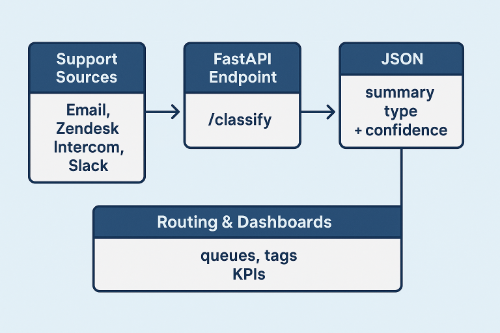
A Million Dollar AI SaaS keeps the control surface tiny: summarize → label → route. Customers already live in Slack, Zendesk, Intercom, and email—so let the outputs flow there.
PROMPT ENGINEERING THAT ACTUALLY SHIPS
Prompt design turns a microservice into a dependable Million Dollar AI SaaS:
- Narrow the label set. Start with
bug,feature,billing. Add new labels only when agents truly need them. - Define labels in one-liners. “
billing: charges, invoices, refunds, discounts.” Short beats verbose. - Low temperature (0–0.3). Consistency > creativity.
- Confidence score. Ask for
0–1. Route< 0.65to human review. - JSON-only replies. Guardrail the output so downstream code stays simple.
COST, RATE LIMITS, AND RELIABILITY
A resilient Million Dollar AI SaaS anticipates failure modes:
- Cache repeats by content hash to avoid duplicate model calls.
- Chunk long threads → summarize chunks → summarize the summaries.
- Retry with exponential backoff on transient errors.
- Graceful degradation. If the model fails, return a safe “needs human review” label with
confidence: 0.0. - Token accounting per workspace to keep margins predictable.
PRIVACY & COMPLIANCE (TRUST IS A FEATURE)
Trust fuels a Million Dollar AI SaaS:
- PII redaction (emails, phones, card-like patterns) before sending text to the model.
- Minimal, structured logs (request ID, latency, model, label, confidence); no raw content unless opted-in.
- Retention policy (e.g., 7 days) and a no-store mode for stricter tenants.
- Self-host/VPC option for regulated customers; document subprocessors and provide a DPA.
INTEGRATIONS: WHERE MILLION DOLLAR AI SAAS LIVES
Zendesk. Trigger on new/updated tickets → POST to /classify → apply tags/queues by type.
Intercom. On new conversation → call the API → set topic/priority or escalate.
Slack. Post summarized results to a triage channel to focus attention.
curl -X POST "$SLACK_WEBHOOK_URL" \
  -H 'Content-type: application/json' \
  -d '{
    "text": "*AI Triage*",
    "blocks": [
      {"type":"section","text":{"type":"mrkdwn","text":"*Type:* billing  •  *Confidence:* 0.94"}},
      {"type":"section","text":{"type":"mrkdwn","text":"Invoice shows $500 due despite prior payment."}},
      {"type":"context","elements":[{"type":"mrkdwn","text":"conversation: abc-123"}]}
    ]
  }'
Zapier/Make. No-code glue for teams that prefer visual flows.
Jira. If type == "bug" and confidence ≥ 0.8, auto-create an issue with the summary as the title.
PRICING A MILLION DOLLAR AI SAAS THAT MAPS TO VALUE
Price against time saved and SLA protection, not against “AI features.”
- Starter — $49/mo: 2,000 classifications, email support.
- Team — $99/mo: 5,000, Slack notifications, weekly report.
- Growth — $249/mo: 15,000, custom labels, SSO, priority support.
- Scale — $499+: higher limits, on-prem/VPC, dedicated Slack.
A Million Dollar AI SaaS grows when customers see hours saved in the first week—then buy more capacity.
METRICS: PROVE ROI FAST
Show the before/after:
- Median First Response Time (target: 20–40% faster within days).
- Resolution Time and SLA adherence (fewer breaches).
- Deflection/Auto-close rate (when paired with a knowledge base).
- Manager hours recaptured (less triage, more coaching).
- Agent CSAT/NPS uplift (clarity reduces burnout).
These are the graphs a Million Dollar AI SaaS puts on its homepage.
DEPLOYMENT (KEEP IT BORING)
Production-ready doesn’t mean complicated. A practical Million Dollar AI SaaS stack:
- $10–$20/mo VPS (2 vCPU, 2 GB RAM) to start.
- Uvicorn + Gunicorn behind Nginx with HTTPS (Let’s Encrypt).
- Environment variables:
OPENAI_API_KEY, workspace quotas, API keys. - Daily log rotation; ship metrics to Grafana/Datadog (or even Sheets at MVP).
- Healthchecks, simple rate limits, and a
/versionendpoint for sanity.
CONTENT AI ENHANCEMENTS (STILL MINIMAL)
A Million Dollar AI SaaS stays lean while adding value:
- Custom label packs. Keep defaults but let admins add 1–3 org-specific labels.
- Saved views & CSV export. Weekly QA of decisions builds trust and surfaces prompt tweaks.
- Guardrails. Regex redaction, input caps, and attachment stripping control cost and risk.
- Human-in-the-loop. Low-confidence items route to reviewers; use feedback to improve prompts.
CODE USAGE EXAMPLES
cURL
curl -s https://api.yourdomain.com/classify \
  -H "Content-Type: application/json" \
  -d '{"text":"Refund requested; duplicate charge on July invoice.","conversation_id":"xyz-789"}'
Python client
import requests
payload = {"text":"Checkout fails on Firefox 128; cannot submit.","conversation_id":"br-42"}
print(requests.post("https://api.yourdomain.com/classify", json=payload).json())
Zapier (outline)
Trigger: new ticket → Action: Webhooks by Zapier (POST /classify) → Filter on type → Route to queue/channel.
THE GO-TO-MARKET FLYWHEEL
How a Million Dollar AI SaaS gets distribution:
- Founder & support communities. A 90-second Loom showing before/after triage.
- Integration pages. “Works with Zendesk / Intercom / Slack,” each with 3-step setup.
- Lead magnet. A free “Support Triage Prompt Pack” helpful even without your API.
- Usage-based trial. 14 days or 1,000 classifications—whichever first.
- Case studies. Publish time-to-first-value and SLA wins; let numbers sell.
FAQ (FOR HUMANS & CRAWLERS)
What’s the difference between summarization and classification?
Summarization compresses a ticket into 1–2 sentences. Classification assigns a label—bug, feature, or billing—so routing becomes instant. Together, they turn text chaos into action—a hallmark of a Million Dollar AI SaaS.
Is GPT-4 necessary?
For messy, real-world text, GPT-4 yields consistent labels. For narrow domains, a smaller model plus heuristics can work; many teams still choose GPT-4 for reliability in a Million Dollar AI SaaS.
Can we expand labels?
Yes—add a few and define each briefly in the system prompt. Keep the total under ~7 to preserve agent trust.
How do we keep costs predictable?
Cache repeats, cap input size, summarize long threads first, and apply per-workspace quotas. Pricing tiers should bake in a safe token budget—vital for a Million Dollar AI SaaS.
Is this replacing agents?
No. It augments them by removing triage drudgery so humans focus on judgment, empathy, and fixes. That’s how a Million Dollar AI SaaS creates durable value.
CLOSING
A thriving Million Dollar AI SaaS doesn’t try to be everything. It does one job—summarize + label—so everything else moves faster. Keep the stack boring, the outputs predictable, and the integrations effortless. That’s how small code compounds into big business.
REFERENCES
- FastAPI Documentation
- OpenAI GPT-4 Models
- Intercom Workflows & Webhooks
- Zendesk Developer Docs
- Stripe: API Keys & Webhooks