


AI career decisions used to feel like guesses. Learn a tool. Copy a project. Hope it works out
Thank you for reading this post, don't forget to subscribe!Table of Contents
But every once in a while, the market sends a clean, unmistakable signal—something so obvious that six months later you wonder how anyone missed it.
That’s what the India AI Impact Summit 2026 felt like.
Not because it was flashy. Not because a few big names showed up (though plenty did). But because the language used on stage—especially PM Modi’s emphasis on democratizing AI and keeping it human-centric—points directly to what the next generation of AI jobs will reward.
Here’s the real takeaway for anyone building an AI career:
The market is moving from “who can demo AI?” to “who can ship AI responsibly?”
That shift changes everything—what you learn, what you build, and what you should put on your portfolio.
Why the India AI Impact Summit 2026 Felt Like a Hiring Forecast
Most conferences are content. This one was context.
The summit brought together political leadership and major tech voices, with coverage emphasizing that India is positioning itself not just as a participant, but as a shaper of the global AI conversation.
That matters because when a country frames AI as a national priority, three “career forces” tend to accelerate:
- Infrastructure & investment
Big AI talk usually triggers big money: compute, data centers, platforms, partnerships, public programs. (Even when the event itself faces logistical criticism, the direction of travel is still clear.) - Rules & trust frameworks
Once leaders emphasize safety, child protection, accountability, or human-centric design, you can expect stronger governance expectations to spread across enterprise and public deployments. - Implementation hiring
Not just “research roles.” Real hiring: solutions engineers, AI product builders, LLMOps, evaluators, governance leads—people who can turn models into outcomes.
If you’re choosing an AI career path, you should care less about the stage lighting and more about the direction of these forces.
The MANAV Vision That Quietly Redefines What an AI Career Means
PM Modi’s message emphasized AI as a “transformative chapter” and pushed for democratizing AI so it becomes a tool for inclusion and empowerment—while keeping humans in control.
Whatever you think of politics, the career implication is practical:
In the next phase, your AI career isn’t judged only by what your model can do.
It’s judged by:
- Who it helps
- Whether it can be trusted
- Whether it can be explained
- Whether it avoids harm
- Whether it respects rights and accountability
This aligns with global frameworks too—OECD’s AI Principles emphasize human-centered values, fairness, transparency, and accountability across the AI lifecycle.
UNESCO’s recommendation similarly stresses safety, human rights, and accountability.
That’s the big shift: the best AI career opportunities won’t just be in “making AI smarter.” They’ll be in making AI usable, safe, and scalable.
The future belongs to builders who can ship AI—and prove it’s safe to use.
The “Democratise AI” Signal That Changes Your Skill Strategy
“Democratise AI” sounds inspirational. For your AI career, it’s a filter.
If AI is meant to be widely accessible, then the most valuable people will be those who can:
- make AI work in real-world constraints (cost, latency, privacy)
- support multiple languages and user contexts
- build guardrails that prevent misuse
- create workflows that non-experts can use safely
This is where many people get stuck: they learn prompts, but they don’t learn systems.
Prompting is a useful skill.
But prompt-only portfolios are already starting to look identical.
An AI career that survives competition is built on systems thinking.
The Global Tech CEO Effect: Why This Matters Beyond India
Coverage of the summit highlighted a stage packed with global tech leadership alongside political leaders.
When that happens, a predictable pattern follows:
- Partnerships form
- Tooling ecosystems form
- Talent pipelines form
Which means the “jobs story” spreads internationally:
- Multinationals expand applied AI teams
- Consulting and integration demand spikes
- Startups chase enterprise adoption
- Governments strengthen procurement and policy capacity
Even if you’re outside India, the AI career lesson is universal: the market is becoming more structured. And when markets become structured, hiring becomes more specific.
Generalists still win—but only if they can ship.
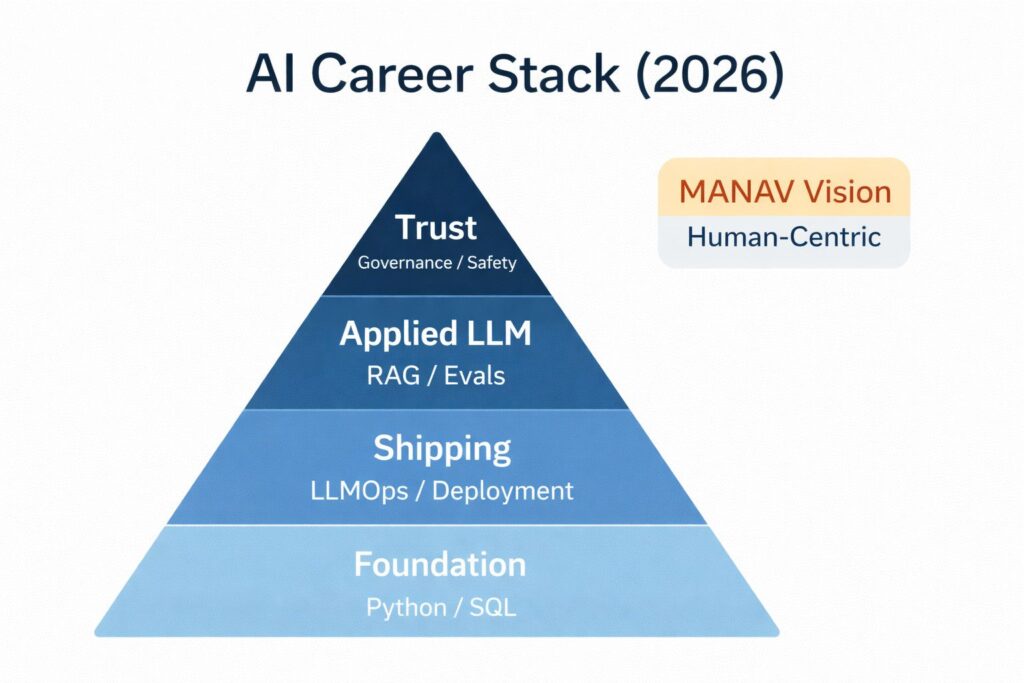
The 4-Layer AI Career Stack You Can Build Without Wasting a Year
If you want an AI career with momentum, build skills like a stack—each layer makes the next easier.
Layer 1: Foundation (the boring part that saves you later)
This is where people try to “skip ahead” and then wonder why they feel stuck.
Focus on:
- Python fundamentals (data types, functions, error handling)
- working with APIs and JSON
- SQL basics (select, join, group by)
- Git + basic debugging habits
This layer doesn’t need to take forever—but it must exist.
Layer 2: Applied LLM (where real leverage begins)
This is the practical middle ground between “prompt influencer” and “PhD researcher.”
Learn:
- embeddings and semantic search
- RAG (retrieval-augmented generation)
- prompt patterns for reliability (role + constraints + examples)
- evaluation basics: accuracy vs faithfulness vs toxicity vs refusal
Layer 3: Shipping (where the money usually lives)
An AI career accelerates when you can ship something that works outside your laptop.
Learn:
- deployment basics (cloud functions, containers, simple hosting)
- logging, monitoring, and feedback loops
- cost and latency tradeoffs
- basic LLMOps: versioning prompts, rollback, guardrails
Layer 4: Trust (the MANAV advantage)
This is where you become hard to replace.
Learn:
- privacy and security basics for AI features
- red-teaming and adversarial prompting tests
- documentation habits: what data, what risks, what mitigations
- governance concepts aligned with standards like OECD and UNESCO
In 2026, “trust” isn’t a philosophy—it’s an employability multiplier.
High-Opportunity AI Career Tracks Most People Ignore
Most people aim for “AI engineer” because it sounds obvious. But the market is widening—and that’s good news for your AI career options.
1) AI Evaluation Specialist (the quality gatekeeper)
Companies are struggling with one question: How do we know the AI is reliable?
If you can build evaluation harnesses, define metrics, and run systematic tests, you become the person teams depend on—especially in regulated or high-stakes domains.
2) AI Product Builder (the “business outcome” translator)
This role wins when you can:
- identify a workflow worth automating
- design the UX so users trust the output
- measure ROI (time saved, errors reduced)
- iterate quickly
An AI career in product is less about model theory and more about judgment.
3) LLMOps / AI Platform Engineer (the scaling engine)
If you like systems:
- observability
- infrastructure
- deployment pipelines
- guardrails
- cost control
This track can be extremely strong because “shipping” at scale is hard—and few people can do it well.
4) Responsible AI / Governance (the trust architect)
As AI governance becomes more prominent, organizations need people who can align practice with principles: accountability, fairness, transparency, and safety.
This is a real AI career track—not a buzzword.
A 60-Day AI Career Plan That Produces Proof (Not Just Certificates)
If you do nothing else, do this: build proof.
The World Economic Forum’s Future of Jobs reporting emphasizes rapid skills change and the need for continuous upskilling—so a portfolio that demonstrates applied capability matters more than ever.
Days 1–20: Build one “painkiller” project
Choose a narrow problem:
- customer support summarizer
- invoice extraction + validation
- knowledge-base assistant for a niche industry
- interview prep assistant that cites sources from your own notes
Rules:
- must accept real input
- must produce structured output
- must log results (even a simple spreadsheet log is fine)
Days 21–40: Add RAG + citations
Connect it to documents and make it cite where it found info.
This one step instantly separates you from generic chatbot clones.
Days 41–60: Add trust + evaluation
Add:
- a “refuse” policy for sensitive requests
- basic PII masking
- an evaluation checklist (10–20 test prompts)
- a simple dashboard: success rate, failure types, top user complaints
Then publish:
- a short write-up
- a 2-minute demo video
- screenshots + metrics
That package is an AI career asset, not a homework assignment.
[Internal Link: /ai-portfolio-project-ideas/]
[Internal Link: /responsible-ai-checklist/]
The “Trust + Shipping” Advantage That Makes You Hard to Replace
Here’s the uncomfortable truth:
The AI field is getting crowded.
Not with experts—with people who look the same on paper.
Same courses. Same “ChatGPT clone.” Same buzzwords.
The advantage is simple:
- Shipping makes you useful.
- Trust makes you safe to hire.
That combination is what human-centric, governance-focused messaging ultimately favors.
Your AI career won’t be defined by what you know. It’ll be defined by what you can safely deploy.
What to Watch Next After the Summit
Don’t obsess over headlines—track outcomes.
Watch these three indicators over the next few months:
- Policy & standards alignment
More language about accountability, human-centric use, and safety typically means stronger expectations for how AI is built and audited. - Infrastructure & investment announcements
Compute and data-center momentum tends to precede hiring waves—especially in platform, integration, and deployment roles. - Real deployments (public + enterprise)
The strongest AI career opportunities often appear where AI goes from “pilot” to “default workflow.”
If you want one guiding question for every decision you make next, use this:
“Will this skill help me ship a trustworthy AI feature that real people use?”
If yes—lean in.
External DoFollow Resources (credible)
- OECD AI Principles (trustworthy AI, human-centered values):
- UNESCO Ethics of AI (safety, accountability, human rights):
- World Economic Forum – Future of Jobs Report 2025 (skills change, AI skills growth):
Before You Leave — Read These to Go Deeper
If this breakdown of the India AI Summit 2026 controversy shifted how you think about AI, optics, and national innovation narratives, don’t stop here.
Sustainable growth — whether in technology, income, or investing — comes from combining skills, systems, and timing.
I’ve broken those ideas down across these in-depth guides:
🚀 Build a One-Person Income System in 2026
https://technichepro.com/one-person-income-system-in-2026-ai-video-generator/
💰 Make $50 a Day Online (Practical, No Hype)
https://technichepro.com/make-50-a-day-online/
📊 Union Budget 2026: Winners, Losers & Market Impact
https://technichepro.com/union-budget-2026-winners-losers-stock-market/
🧠 Explore More Money & Finance Guides
https://technichepro.com/category/money-finance/
🔥 Trending Deep Dives You Shouldn’t Miss
https://technichepro.com/500-for-your-voice-7-shocking-reasons-this-get-paid-for-your-voice-ai-side-hustle-is-exploding-in-2026/
Source:
- https://www.ndtv.com/india-news/india-ai-impact-summit-2026-live-updates-bharat-mandapam-new-delhi-global-tech-leaders-pm-modi-to-inaugurate-ai-impact-summit-day-4-emmanuel-macron-11056518
- https://www.ndtvprofit.com/technology/ai-impact-summit-2026-day-4-live-updates-pm-modi-to-inaugurate-indian-ai-impact-summit-day-in-new-delhi-events-speakers-11056457
- https://timesofindia.indiatimes.com/technology/tech-news/india-ai-impact-summit-2026-day-4-google-ceo-sundar-pichai-openai-ceo-sam-altman-anthropic-ceo-dario-amodei-and-other-tech-leaders-to-deliver-keynote/articleshow/128537708.cms?utm_source=chatgpt.com
- https://www.reuters.com/world/india/bill-gates-cancels-keynote-address-india-ai-summit-2026-02-19?utm_source=chatgpt.com