


Table of Contents
If you’ve ever tried to build an AI agent from scratch, you’ve probably seen this:
Thank you for reading this post, don't forget to subscribe!- It “thinks” forever.
- It keeps calling tools in a loop.
- It repeats itself.
- It burns tokens like a leaking pipe.
That’s not an AI agent. That’s a confused chatbot with tools.
In this post, you’ll build an AI agent from scratch in Python (no LangChain, no frameworks) using a minimal agent loop that actually works:
✅ Tool calling (safe + predictable)
✅ Memory (short-term + long-term)
✅ Planning + replanning (simple, not fancy)
✅ Hard stop conditions (so it won’t spiral)
✅ A trace log you can debug and improve
By the end, you’ll have a clean, copy-paste-ready agent you can use as the base for real products.
What “AI Agent” Really Means (In Plain English)
To build an AI agent from scratch, you only need one idea:
An agent is a loop.
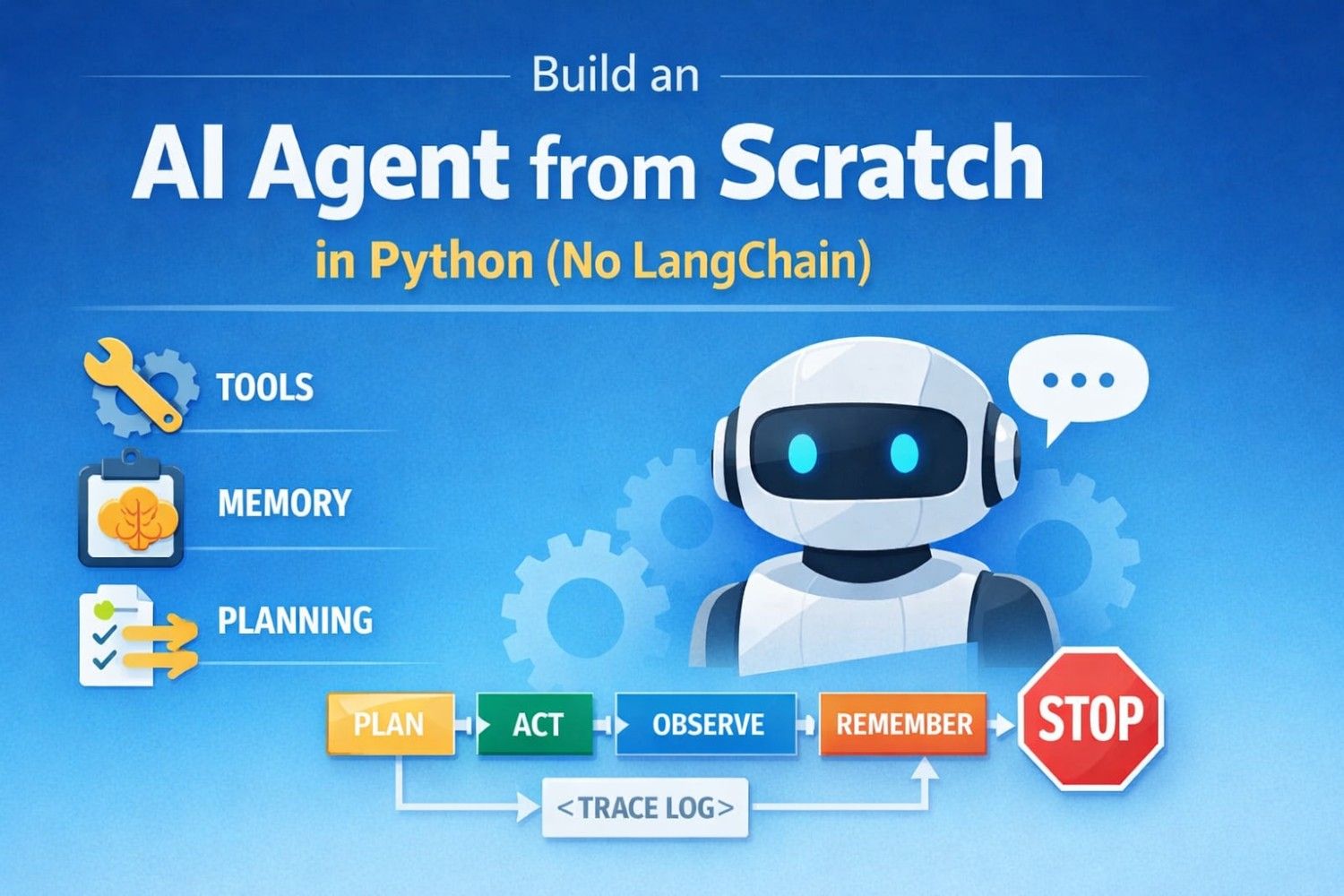
Plan → Act (tool) → Observe → Remember → Replan → Stop
That’s it.
A chatbot answers once.
An agent can decide what to do next, use tools, and keep going until it’s done.
The big secret is this:
A good agent is not “smart.”
A good agent is controlled.
So we’ll focus on control: structured output, tool safety, memory compression, and stop conditions.
The Agent Design (Minimal and Practical)
We will implement:
1) Tools
A tool is just a Python function with:
- a name
- a description
- a JSON schema for inputs
2) Memory
Two layers:
- Short-term memory: recent conversation + tool results
- Long-term memory: compact notes saved to disk and retrieved later
3) Planning
Two layers:
- High-level plan: 3–6 bullets
- Next action: one step (call a tool or answer)
4) Stop Conditions (This is what makes it “real”)
Hard limits:
- max steps
- max tool calls
- max time
- repeated actions detection
Soft limits:
- if no new progress for 2 steps, stop
- if plan is stable but output is ready, finalize
This is the difference between a “demo agent” and an agent people trust.
Full Working Code: Minimal AI Agent in Pure Python (No LangChain)
Copy-paste this into a single file: agent_from_scratch.py
"""
agent_from_scratch.py
------------------------------------------------------------
A minimal AI agent loop in pure Python (no LangChain).
- Tools: registry + safe execution
- Memory: short-term + long-term notes (file-based)
- Planning: simple plan + next step
- Guardrails: max steps, max tool calls, loop detection
- Debug: trace log per step

Requirements:
- Python 3.10+
- requests (pip install requests)

Environment:
- OPENAI_API_KEY (required)
- OPENAI_BASE_URL (optional, default: https://api.openai.com/v1)
- OPENAI_MODEL (optional, default: gpt-4o-mini)
"""

from __future__ import annotations

import json
import os
import time
import re
from dataclasses import dataclass, field
from typing import Any, Callable, Dict, List, Optional, Tuple

import requests


# -----------------------------
# Utilities
# -----------------------------

def now_ms() -> int:
    return int(time.time() * 1000)

def clamp_text(text: str, max_chars: int = 1800) -> str:
    text = text.strip()
    if len(text) <= max_chars:
        return text
    return text[:max_chars] + " ...[truncated]"

def safe_json_extract(text: str) -> Optional[Dict[str, Any]]:
    """
    The model must output a single JSON object.
    This function tries to extract the first JSON object from the response safely.
    """
    text = text.strip()
    # Fast path: pure JSON
    if text.startswith("{") and text.endswith("}"):
        try:
            return json.loads(text)
        except Exception:
            pass

    # Extract first {...} block
    match = re.search(r"\{.*\}", text, flags=re.DOTALL)
    if not match:
        return None
    blob = match.group(0)
    try:
        return json.loads(blob)
    except Exception:
        return None

def simple_similarity(a: str, b: str) -> float:
    """
    Tiny loop-detection heuristic: token overlap ratio.
    Good enough to detect 'same action again and again'.
    """
    sa = set(a.lower().split())
    sb = set(b.lower().split())
    if not sa or not sb:
        return 0.0
    return len(sa & sb) / max(1, len(sa | sb))


# -----------------------------
# Tool System
# -----------------------------

@dataclass
class Tool:
    name: str
    description: str
    schema: Dict[str, Any]
    fn: Callable[[Dict[str, Any]], Any]
    safe: bool = True  # keep dangerous tools behind a flag

class ToolRegistry:
    def __init__(self) -> None:
        self._tools: Dict[str, Tool] = {}

    def register(self, tool: Tool) -> None:
        if tool.name in self._tools:
            raise ValueError(f"Tool already registered: {tool.name}")
        self._tools[tool.name] = tool

    def get(self, name: str) -> Optional[Tool]:
        return self._tools.get(name)

    def as_prompt_block(self) -> str:
        """
        Give the model the tool list in a compact, readable form.
        """
        lines = ["TOOLS AVAILABLE:"]
        for t in self._tools.values():
            safe_tag = "safe" if t.safe else "restricted"
            lines.append(f"- {t.name} ({safe_tag}): {t.description}")
            lines.append(f"  schema: {json.dumps(t.schema, ensure_ascii=False)}")
        return "\n".join(lines)


# -----------------------------
# Memory System
# -----------------------------

@dataclass
class MemoryNote:
    ts_ms: int
    text: str
    tags: List[str] = field(default_factory=list)

class LongTermMemory:
    """
    Simple long-term memory:
    - Stores compact notes in a JSONL file
    - Retrieves notes with keyword overlap (simple, fast, no embeddings)
    """
    def __init__(self, path: str = "agent_memory.jsonl") -> None:
        self.path = path
        if not os.path.exists(self.path):
            with open(self.path, "w", encoding="utf-8") as f:
                f.write("")

    def add(self, text: str, tags: Optional[List[str]] = None) -> None:
        note = MemoryNote(ts_ms=now_ms(), text=text.strip(), tags=tags or [])
        with open(self.path, "a", encoding="utf-8") as f:
            f.write(json.dumps(note.__dict__, ensure_ascii=False) + "\n")

    def search(self, query: str, k: int = 5) -> List[MemoryNote]:
        query_tokens = set(query.lower().split())
        scored: List[Tuple[float, MemoryNote]] = []
        with open(self.path, "r", encoding="utf-8") as f:
            for line in f:
                line = line.strip()
                if not line:
                    continue
                try:
                    obj = json.loads(line)
                    note = MemoryNote(**obj)
                    tokens = set(note.text.lower().split())
                    score = len(tokens & query_tokens)
                    if score > 0:
                        scored.append((float(score), note))
                except Exception:
                    continue

        scored.sort(key=lambda x: x[0], reverse=True)
        return [n for _, n in scored[:k]]

class ShortTermMemory:
    """
    Keeps the last N messages (compressed).
    """
    def __init__(self, max_items: int = 18) -> None:
        self.max_items = max_items
        self.items: List[Dict[str, str]] = []

    def add(self, role: str, content: str) -> None:
        self.items.append({"role": role, "content": content})
        if len(self.items) > self.max_items:
            self.items = self.items[-self.max_items:]


# -----------------------------
# LLM Client (simple, direct)
# -----------------------------

class LLMClient:
    def __init__(self) -> None:
        self.api_key = os.getenv("OPENAI_API_KEY", "").strip()
        if not self.api_key:
            raise RuntimeError("Missing OPENAI_API_KEY")

        self.base_url = os.getenv("OPENAI_BASE_URL", "https://api.openai.com/v1").strip()
        self.model = os.getenv("OPENAI_MODEL", "gpt-4o-mini").strip()

    def chat(self, messages: List[Dict[str, str]], temperature: float = 0.2) -> str:
        url = f"{self.base_url}/chat/completions"
        headers = {"Authorization": f"Bearer {self.api_key}"}
        payload = {
            "model": self.model,
            "temperature": temperature,
            "messages": messages,
        }
        r = requests.post(url, headers=headers, json=payload, timeout=60)
        r.raise_for_status()
        data = r.json()
        return data["choices"][0]["message"]["content"]


# -----------------------------
# Agent Core
# -----------------------------

@dataclass
class AgentConfig:
    max_steps: int = 10
    max_tool_calls: int = 6
    max_seconds: int = 35
    allow_restricted_tools: bool = False

@dataclass
class AgentState:
    step: int = 0
    tool_calls: int = 0
    started_ms: int = field(default_factory=now_ms)
    high_level_plan: List[str] = field(default_factory=list)
    last_actions: List[str] = field(default_factory=list)
    trace: List[Dict[str, Any]] = field(default_factory=list)

class ScratchAgent:
    """
    A minimal agent that:
    - asks the model for a plan + next action
    - executes a tool if needed
    - stores memory notes
    - stops safely
    """
    def __init__(self, llm: LLMClient, tools: ToolRegistry, ltm: LongTermMemory, cfg: AgentConfig) -> None:
        self.llm = llm
        self.tools = tools
        self.ltm = ltm
        self.cfg = cfg
        self.stm = ShortTermMemory(max_items=18)

    def _time_left(self, state: AgentState) -> int:
        elapsed = now_ms() - state.started_ms
        return max(0, self.cfg.max_seconds * 1000 - elapsed)

    def _should_stop(self, state: AgentState) -> Optional[str]:
        if state.step >= self.cfg.max_steps:
            return "Reached max_steps"
        if state.tool_calls >= self.cfg.max_tool_calls:
            return "Reached max_tool_calls"
        if self._time_left(state) <= 0:
            return "Reached max_seconds"

        # Loop detection: if we keep repeating very similar actions
        if len(state.last_actions) >= 3:
            a, b, c = state.last_actions[-3:]
            if simple_similarity(a, b) > 0.85 and simple_similarity(b, c) > 0.85:
                return "Detected repeating loop"

        return None

    def _compact_memory_summary(self) -> str:
        """
        Summarize short-term memory in a compact form the agent can carry.
        """
        # Keep it simple: last 8 items only, compressed.
        tail = self.stm.items[-8:]
        lines = []
        for it in tail:
            role = it["role"]
            content = clamp_text(it["content"], 260).replace("\n", " ")
            lines.append(f"{role}: {content}")
        return "\n".join(lines)

    def _build_system_prompt(self, user_goal: str) -> str:
        """
        The strongest part: strict output format + clear behavior.
        """
        return f"""
You are a strict AI agent. Your job is to complete the user's goal safely and efficiently.

USER GOAL:
{user_goal}

RULES:
- You MUST respond with exactly ONE JSON object and nothing else.
- Choose ONE action per step.
- If you have enough info, finish with a final answer.
- Keep plans short and simple.
- Avoid infinite loops. If stuck, explain what is missing and finish.

OUTPUT JSON SCHEMA:
{{
  "type": "plan" | "tool_call" | "final",
  "plan": ["..."] (required if type="plan"),
  "next": "... one sentence next step ..." (required if type="plan"),
  "tool": "tool_name" (required if type="tool_call"),
  "args": {{...}} (required if type="tool_call"),
  "answer": "... final answer ..." (required if type="final"),
  "memory_note": "... short durable note to store ..." (optional)
}}

AVAILABLE TOOLS:
{self.tools.as_prompt_block()}
""".strip()

    def _model_step(self, user_goal: str, state: AgentState) -> Dict[str, Any]:
        ltm_hits = self.ltm.search(user_goal, k=4)
        ltm_block = "\n".join([f"- {clamp_text(n.text, 240)}" for n in ltm_hits]) or "- (none)"

        system = self._build_system_prompt(user_goal)
        context = f"""
SHORT-TERM MEMORY (compact):
{self._compact_memory_summary()}

LONG-TERM MEMORY (top hits):
{ltm_block}

CURRENT PLAN:
{state.high_level_plan if state.high_level_plan else "(not set)"}

STEP: {state.step}
TOOL_CALLS: {state.tool_calls}
TIME_LEFT_MS: {self._time_left(state)}
""".strip()

        messages = [
            {"role": "system", "content": system},
            {"role": "user", "content": context},
        ]

        raw = self.llm.chat(messages, temperature=0.2)
        obj = safe_json_extract(raw)
        if not obj:
            # fallback: force finish to avoid chaos
            return {"type": "final", "answer": clamp_text(raw, 900)}
        return obj

    def _run_tool(self, name: str, args: Dict[str, Any]) -> Dict[str, Any]:
        tool = self.tools.get(name)
        if not tool:
            return {"ok": False, "error": f"Unknown tool: {name}", "data": None, "latency_ms": 0}

        if (not tool.safe) and (not self.cfg.allow_restricted_tools):
            return {"ok": False, "error": f"Tool is restricted: {name}", "data": None, "latency_ms": 0}

        t0 = now_ms()
        try:
            out = tool.fn(args)
            return {"ok": True, "error": None, "data": out, "latency_ms": now_ms() - t0}
        except Exception as e:
            return {"ok": False, "error": str(e), "data": None, "latency_ms": now_ms() - t0}

    def run(self, user_goal: str) -> str:
        state = AgentState()
        self.stm.add("user", user_goal)

        while True:
            stop_reason = self._should_stop(state)
            if stop_reason:
                final = f"I’m stopping safely: {stop_reason}.\n\nWhat I can do next: clarify missing info or reduce scope."
                self.stm.add("assistant", final)
                return final

            state.step += 1

            decision = self._model_step(user_goal, state)
            dtype = decision.get("type", "").strip()

            trace_item: Dict[str, Any] = {
                "step": state.step,
                "decision": decision,
                "tool_result": None,
            }

            # Store memory note (if provided)
            mem_note = (decision.get("memory_note") or "").strip()
            if mem_note:
                self.ltm.add(mem_note, tags=["agent_note"])

            if dtype == "plan":
                plan = decision.get("plan") or []
                if isinstance(plan, list) and plan:
                    state.high_level_plan = [str(x)[:140] for x in plan][:6]
                nxt = str(decision.get("next") or "").strip()
                state.last_actions.append("plan:" + nxt)
                self.stm.add("assistant", f"PLAN: {state.high_level_plan}\nNEXT: {nxt}")
                state.trace.append(trace_item)
                continue

            if dtype == "tool_call":
                tool_name = str(decision.get("tool") or "").strip()
                args = decision.get("args") or {}
                if not isinstance(args, dict):
                    args = {}

                state.tool_calls += 1
                action_sig = f"tool:{tool_name} args:{json.dumps(args, sort_keys=True)}"
                state.last_actions.append(action_sig)

                result = self._run_tool(tool_name, args)
                trace_item["tool_result"] = result
                state.trace.append(trace_item)

                obs = {
                    "tool": tool_name,
                    "ok": result["ok"],
                    "error": result["error"],
                    "data": clamp_text(json.dumps(result["data"], ensure_ascii=False), 1200) if result["ok"] else None,
                    "latency_ms": result["latency_ms"],
                }
                self.stm.add("assistant", f"TOOL_OBSERVATION: {json.dumps(obs, ensure_ascii=False)}")
                continue

            # Final answer
            answer = str(decision.get("answer") or "").strip()
            if not answer:
                answer = "Done."
            self.stm.add("assistant", answer)
            return answer


# -----------------------------
# Tools (safe, useful)
# -----------------------------

def tool_calc(args: Dict[str, Any]) -> Any:
    expr = str(args.get("expression", "")).strip()
    if not expr:
        raise ValueError("Missing expression")
    # Very small safe evaluator: numbers + operators only
    if not re.fullmatch(r"[0-9\.\+\-\*\/\(\)\s]+", expr):
        raise ValueError("Expression contains unsupported characters")
    return eval(expr, {"__builtins__": {}}, {})

def tool_summarize(args: Dict[str, Any]) -> Any:
    text = str(args.get("text", "")).strip()
    max_lines = int(args.get("max_lines", 6))
    text = clamp_text(text, 3000)
    lines = [ln.strip() for ln in text.splitlines() if ln.strip()]
    # Simple heuristic summary: take first lines + key bullets
    out = []
    for ln in lines[:max_lines]:
        out.append(ln[:180])
    return out

def tool_read_file(args: Dict[str, Any]) -> Any:
    path = str(args.get("path", "")).strip()
    if not path:
        raise ValueError("Missing path")
    # Basic sandbox: block parent traversal
    if ".." in path.replace("\\", "/"):
        raise ValueError("Parent traversal is not allowed")
    with open(path, "r", encoding="utf-8") as f:
        return clamp_text(f.read(), 6000)

def build_tools() -> ToolRegistry:
    reg = ToolRegistry()

    reg.register(Tool(
        name="calc",
        description="Evaluate a simple math expression safely (numbers + + - * / parentheses).",
        schema={"type": "object", "properties": {"expression": {"type": "string"}}, "required": ["expression"]},
        fn=tool_calc,
        safe=True,
    ))

    reg.register(Tool(
        name="summarize",
        description="Create a short bullet summary from text (fast heuristic).",
        schema={"type": "object", "properties": {"text": {"type": "string"}, "max_lines": {"type": "integer"}}, "required": ["text"]},
        fn=tool_summarize,
        safe=True,
    ))

    reg.register(Tool(
        name="read_file",
        description="Read a local text file (sandboxed; blocks .. traversal).",
        schema={"type": "object", "properties": {"path": {"type": "string"}}, "required": ["path"]},
        fn=tool_read_file,
        safe=False,  # file access is restricted by default
    ))

    return reg


# -----------------------------
# Demo
# -----------------------------

if __name__ == "__main__":
    llm = LLMClient()
    tools = build_tools()
    ltm = LongTermMemory(path="agent_memory.jsonl")

    cfg = AgentConfig(
        max_steps=10,
        max_tool_calls=6,
        max_seconds=35,
        allow_restricted_tools=False,
    )

    agent = ScratchAgent(llm=llm, tools=tools, ltm=ltm, cfg=cfg)

    goal = (
        "Create a short plan to write a Medium post about building an AI agent from scratch in Python "
        "with tools, memory, planning, and stop conditions. Then produce the final outline."
    )

    print(agent.run(goal))
Why This “From Scratch” Agent Actually Works
If you want your post to go viral, this is the part readers remember:
1) It forces structured JSON output
Agents break when outputs are messy. Here, the model must choose:
plantool_callfinal
That one decision removes 80% of agent chaos.
2) It treats tool outputs as observations
The agent doesn’t “guess.”
It acts, observes, and updates memory.
3) It has real stop conditions
Most “agent from scratch” tutorials ignore this.
But stop conditions are what make your agent reliable.
If your agent can’t stop, it’s not an agent — it’s a runaway process.
4) Memory is compact by design
Short-term memory is trimmed.
Long-term memory stores only durable notes.
This prevents context bloat, which is the silent killer of agent performance.
How to Make This Agent Feel “Smart” Without Making It Complex
If you want to build an AI agent from scratch that feels impressive to readers, add these upgrades next:
Upgrade A: Memory Compression (Token Saver)
Every 4–5 steps, replace the “chat history” with a tight summary:
- what we know
- what we tried
- what’s next
This makes agents faster, cheaper, and less repetitive.
Upgrade B: Reflection (One Extra Pass)
After the agent produces a final answer, do one more call:
- “Find weaknesses”
- “Fix them once”
That single loop makes output quality jump.
Upgrade C: Better Tool Contracts
Return tool results in a consistent envelope:
- ok
- data
- error
- latency
Your agent becomes debuggable and production-friendly.
The Viral Angle: The “Agent Loop Problem” (And the Fix)
Here’s a simple truth most people don’t say clearly:
Agents fail because they don’t know when to stop.
Your readers have felt this pain.
So make the “viral hook” crystal clear:
- “My agent kept looping and burned tokens.”
- “I fixed it with four guardrails.”
- “Here is the exact code.”
That’s shareable. That gets claps.
Real Use Cases Readers Will Share
If you want max claps and shares, tie your build AI agent from scratch tutorial to a real-life workflow people want:
1) Repo Triage Agent
- reads error logs
- suggests root cause
- proposes patch plan
2) Document Agent
- reads PDFs / contracts / policies
- extracts facts
- creates a clean summary
3) Research → Write → Verify Agent
- gathers info (from your own sources)
- drafts content
- checks gaps
- improves clarity
Pick one and add a short demo story around it. Stories beat theory.
Final Words (And Your Next Step)
If you came here to build an AI agent from scratch, you now have the cleanest foundation:
- tools
- memory
- planning
- guardrails
- simple Python
- no frameworks
This is not “toy code.”
This is a solid base you can turn into a product.
If you want more practical AI + Python guides, I also write on my blog:
- Tech Niche Pro (main): https://technichepro.com/
- Build Wealth on a Salary (simple system): https://technichepro.com/build-wealth-on-a-salary-simple-system/
- AI Smart Career 2026: https://technichepro.com/ai-smart-career-2026/
- The Next AI Boom 2026: https://technichepro.com/next-ai-boom-2026/
If this helped you, share it with one builder friend who’s struggling with agent loops.
Bonus resources:
— YouTube ▶️ https://youtu.be/GHy73SBxFLs
— Book ▶️ https://www.amazon.com/dp/B0CKGWZ8JT
Let’s Connect
Email: krtarunsingh@gmail.com
LinkedIn: Tarun Singh
GitHub: github.com/krtarunsingh
Buy Me a Coffee: https://buymeacoffee.com/krtarunsingh
YouTube: @tarunaihacks
👉 If you found value here, clap, share, and leave a comment — it helps more devs discover practical guides like this.
More Builds You’ll Love
On-Device AI Is Finally Real — Build a Copilot+ PC App That Runs 100% Offline
On-device AI, explained in plain English — with a full working project you can run today.pub.towardsai.net
Laptop-Only LLM: Tune Google Gemma 3 in Minutes (Code Inside)
A clean, from-scratch walkthrough (with code) to tune a 270M-param LLM on chess — no cloud required.pub.towardsai.net
Build an AI PDF Search Engine in a Weekend (Python, FAISS, RAG — Full Code)
Turn messy folders of PDFs into a blazing-fast, AI-assisted knowledge base you can actually talk to.pub.towardsai.net
The Next AI Boom: What Comes After AI Agents and Agentic AI?
Artificial Intelligence is no longer science fiction. It’s a living, breathing force that’s already transforming how we…medium.com
AI-Powered OCR with Phi-3-Vision-128K: The Future of Document Processing
In the fast-evolving world of artificial intelligence, multimodal models are setting new standards for integrating…ai.gopubby.com
RAG Frameworks Explored: LlamaIndex vs. LangChain for Next-Gen LLMs
The Rise of Large Language Models (LLMs)ai.gopubby.com
Mastering RAG Chunking Techniques for Enhanced Document Processing
Dividing large documents into smaller parts is a crucial yet intricate task that significantly impacts the performance…ai.gopubby.com
📖 Ready to rebuild with me?
Rebuild: Your next version is only one decision away
Rebuild: Your next version is only one decision away
Rebuild: Your next version is only one decision away [Singh, Tarun] on Amazon.com. *FREE* shipping on qualifying…www.amazon.com