

Table of Contents

AI-Smart Career 2026 isn’t about surviving automation—it’s about thriving by combining human judgment with AI leverage. The narrative that “AI will replace everyone” is already outdated. In PwC’s 2025 AI Jobs Barometer, wages in AI-exposed industries grew nearly twice as fast as in others, and productivity per employee surged as companies learned to embed AI into workflows.
Microsoft’s Work Trend Index further confirms that three-quarters of knowledge workers now use AI tools daily for drafting, coding, analysis, or communication. The real winners aren’t those who fear AI—they’re the ones multiplying their output with it. That’s why this guide goes deep into roles, salaries, skills, Python stacks, and concrete roadmaps you can use to future-proof your income. By the end, you’ll have clarity on exactly where to place your bets and how to demonstrate value in interviews and portfolios.
2026 HIRING REALITY (AND WHY YOUR TIMING IS PERFECT)
AI-Smart Career 2026 opportunities are peaking because the adoption curve has crossed into mainstream. Three macro signals matter:
- Bottom-up adoption → workers are quietly embedding AI tools into daily routines (drafting emails, summarizing meetings, analyzing data) often before official policies are written.
- Real productivity gains → early research confirms AI saves hours weekly, particularly in repetitive cognitive tasks.
- Demand outpaces supply → employers reward candidates who show AI literacy with promotions and salary bumps.
Supporting insights:
- Microsoft’s blog → emphasizes that AI fluency compresses cycle times across roles in product, ops, design, and support.
- World Economic Forum’s “Future of Jobs 2025” → notes employers expect net job creation, not loss, especially in AI-complementary fields like compliance, human-computer interaction, and product development.
In plain terms: the jobs won’t vanish; they’ll evolve, pay more, and favor those who adapt fastest.
Source: World Economic Forum Future of Jobs Report
THE REALITY: AI IS A CATALYST, NOT A REPLACEMENT
The myth that AI will take away every job has been repeated so often that many people have started to fear it. But the truth about AI-Smart Career 2026 is very different. The data shows that professionals who embrace AI skills 2026 are not only keeping their roles but are also earning significantly more than their peers. Multiple studies highlight that workers who actively integrate AI into their workflows are enjoying salary premiums of 50–60% compared to those who resist adoption. Instead of shrinking opportunities, AI is acting as a catalyst for growth, creating entire categories of future-proof jobs.
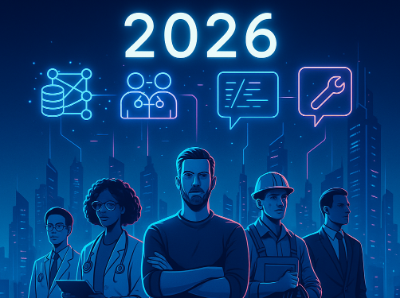
What makes this shift so powerful is that AI doesn’t erase human strengths—it amplifies them. Organizations in every sector—from finance and law to healthcare, education, and skilled trades—are actively recruiting for AI careers 2026 that blend judgment, empathy, and domain knowledge with fluency in modern AI tools. Far from being a replacement, AI is a force multiplier that allows people to focus on the higher-value parts of their roles.
Consider how human-AI collaboration works in practice. Lawyers and compliance officers use retrieval-augmented systems to quickly surface precedents while still applying critical reasoning to the final argument. Doctors combine AI diagnostics with bedside judgment, ensuring patients get faster and safer care. Designers leverage generative tools to iterate visuals but still bring cultural meaning and human context. Even electricians and HVAC specialists are using AI for smarter diagnostics, but the unpredictable, hands-on work still requires skilled people. In each case, humans don’t disappear—they step into more valuable positions.
This is why the most resilient AI-Smart Career 2026 roles are those that see AI as an enabler rather than an enemy. By learning to harness AI for drafting, planning, analysis, and communication, professionals create leverage that cannot easily be automated away. It’s not about competing with algorithms; it’s about collaborating with them to expand what’s possible. The future is already rewarding those who see AI as a partner. If you align yourself with this reality, you won’t just protect your role—you’ll accelerate your income, relevance, and long-term career growth.
THE HIGH-VALUE “AI + HUMAN” ROLES FOR 2026 (WITH PAY NOTES)
Salary ranges vary widely by region, seniority, and company stage. Use these bands as directional: U.S. top-tier tech hubs tend to pay the high end (or above), Europe and APAC major metros somewhat lower, and India’s leading firms closing quickly at the senior end. Your bargaining power rises sharply when you demonstrate measurable AI leverage (e.g., “I automated X, reduced time by Y%, cut costs by Z”). Where possible, we include notes on India opportunities and remote-friendly roles.
Building an AI-Smart Career 2026 means understanding that the future is not about replacing humans but about creating exponential leverage through human-AI collaboration. Employers are increasingly searching for candidates who can merge technical literacy with judgment, creativity, and ethical responsibility. Salary ranges continue to rise, particularly for roles where AI skills 2026 are paired with domain knowledge and a track record of shipping production-ready outcomes. These roles form the backbone of future-proof jobs that cannot be easily automated away. Instead, they expand in scope and reward as AI becomes embedded in every sector.
- AI Product Manager (PM): This role anchors many AI careers 2026 because it requires translating business problems into AI-powered solutions that deliver measurable results. Beyond backlog prioritization, PMs set success metrics, choose between hosted APIs and local LLMs, and design feedback loops. A PM who can show they’ve cut product launch cycles by 40% with AI-enabled prototyping is positioned as a strategic multiplier. Stack includes Python + FastAPI, RAG with LlamaIndex/LangChain, and Postgres + pgvector. Pay ranges US $140k–$240k; India ₹35L–₹90L+. This is a flagship future-proof job.
- LLMOps Engineer: At the core of AI-Smart Career 2026 are professionals who operationalize large language models. Their impact is measured in uptime, safety, latency, and cost. With companies burning millions in GPU costs, engineers who can deploy LangGraph workflows, implement semantic caching, and manage ONNX/Triton optimizations are irreplaceable. Salary bands are strong: US $150k–$260k; India ₹40L–₹1Cr. LLMOps roles are some of the most resilient and lucrative AI careers 2026.
- Data Engineer (AI-ready): Every AI pipeline begins with trustworthy data. Data Engineers are evolving from SQL and Spark experts into future-proof jobs that include text-heavy ETL, PII governance, and embeddings. Stack: Python, Airflow, dbt, Spark, Kafka, and Great Expectations for validation. Pay: US $130k–$220k; India ₹28L–₹70L. Pairing traditional data pipeline skills with AI skills 2026 like retrieval-augmented generation immediately elevates career prospects.
- Human-AI Interaction Designer: Designing interfaces where people trust AI outputs requires empathy and creativity—hallmarks of human-AI collaboration. These designers choreograph voice tone, error handling, confidence-based recovery, and escalation to human support. Tools include Figma, Streamlit, and prompt libraries. Pay: US $110k–$190k; India ₹22L–₹55L. These roles are critical to AI careers 2026 in consumer apps, education, and healthcare, where usability and trust drive adoption.
- Prompt & Workflow Engineer: Often misunderstood as “prompt writing,” this role has matured into building structured, repeatable workflows with metrics. The best workflow engineers in AI-Smart Career 2026 use pydantic schemas, JSONMode, and LangGraph to design agents that deliver stable outputs. Pay: US $130k–$200k; India ₹28L–₹65L. These roles exemplify AI skills 2026 because they require a mix of coding, evaluation, and domain knowledge.
- On-Device AI Developer: As laptops ship with NPUs and phones become inference-ready, edge deployment is booming. This role is key in AI careers 2026 because organizations want private, low-latency AI. Developers skilled in PyTorch, ONNX Runtime, WebGPU, and MLX can package models for offline execution. Pay: US $140k–$210k; India ₹30L–₹70L. These are among the most exciting future-proof jobs because they combine privacy, speed, and accessibility.
- AI Security & Trust Engineer: Security defines the sustainability of AI-Smart Career 2026. These engineers prevent prompt injections, protect data, and monitor abuse patterns. Skills include threat modeling, Python probes, eBPF runtime signals, and adversarial evaluation. Pay: US $150k–$240k; India ₹40L–₹1Cr. With increasing regulations, security roles in AI careers 2026 are only accelerating.
- AI Ethics & Compliance Officer: As governments regulate AI usage, demand is surging for officers who bridge legal frameworks and technical realities. This is one of the most stable future-proof jobs because every company deploying AI at scale must demonstrate fairness, accessibility, and alignment with regulations. Pay: US $140k–$220k; India ₹35L–₹75L. These professionals exemplify human-AI collaboration in governance.
- Domain Expert + AI Amplifier: Lawyers, doctors, and financial analysts who integrate AI retrieval systems into workflows become force multipliers. Adding AI skills 2026 like secure retrieval and audit trails to deep domain knowledge ensures these experts remain central to decision-making. Pay: US $120k–$220k+; India ₹25L–₹80L. These hybrid professionals represent the heart of AI-Smart Career 2026 because they bridge technical systems with regulated human outcomes.
- Skilled Trades with AI Tools: The surprising winners in AI careers 2026 are electricians, plumbers, and HVAC specialists. These hands-on roles can’t be replaced but are enhanced by AI diagnostics, AR troubleshooting, and client communication assistants. According to the U.S. Bureau of Labor Statistics, demand is projected to grow above average into the 2030s. These are blue-collar future-proof jobs, reinforced by human-AI collaboration in real-world environments.
HUMAN ADVANTAGE: THE FIVE META-SKILLS MACHINES WON’T BEAT (AND HOW TO PRACTICE THEM)
- Problem FramingTurn ambiguous goals into testable problems. Practice by rewriting vague requests into crisp objectives, constraints, and KPIs. Teach your AI tool the frame (“act as a product coach…”) before asking for outputs.2) JudgmentUnder uncertainty, decide with limited info. Use “three-option” drills: baseline, bold, conservative—with pros/cons and risk notes.3) Communication & FacilitationRun better meetings and docs. Use AI for first drafts; you own clarity, tone, and narrative arc.4) Ethics & RiskSense when to slow down. Apply a simple risk heatmap: data sensitivity, user impact, reversibility.5) Learning VelocityThe #1 career moat is speed of skill acquisition. Build “micro-apprenticeships”: two-week sprints to master one API or library to a portfolio-ready outcome. (And yes, lifelong learning is now the default labor market requirement.) World Economic Forum
THE 30/60/90-DAY AI CAREER ACCELERATOR (WORKS FOR ANY ROLE)
DAYS 1–30: FOUNDATIONS AND PROOF OF SPEED
- Choose a role track (from the list above) and commit to a 90-day flagship project.
- Tool up:
- Python 3.11+, VS Code, Git/GitHub, Docker Desktop
- Create a single repo:
ai-workbench/with subfolders per experiment
- Learn one orchestration stack end-to-end:
- LangChain or LlamaIndex + vector DB (pgvector on Postgres)
- Ship a working RAG app that answers real questions over a small corpus (policy docs, product manuals, contracts)
- Start an “AI ops” habit:
- Instrument every experiment with logging, cost tracking, and an eval harness
- Track precision/recall for retrieval and rubric scores for generation
- Portfolio #1 (proof of speed):
- 5-minute Loom or short blog post with before/after
- Quantify: “reduced doc triage from 45 → 9 minutes with audit trail”; include quality checks
DAYS 31–60: DEPTH + DOMAIN
- Add a domain corpus: choose finance, support tickets, compliance SOPs, or API docs
- Implement stronger retrieval patterns:
- Hybrid search (BM25 + embeddings)
- Metadata filters, sliding-window chunking, citations
- Add HITL (human-in-the-loop):
- Include a review/approval step; store adjudications to improve prompts and filters
- Security & privacy basics:
- Redact PII before indexing
- Use a secrets manager
- Add guardrails for policy violations
- Portfolio #2 (tool-for-one):
- Ship an internal tool that measurably reduces your own work
- Example: proposal-builder that drafts ~70% of a client proposal with correct references and a cost table
DAYS 61–90: PRODUCTION HABITS
- Containerize and stage:
- Dockerize; set up dev/stage/prod environments
- Wire CI to run tests + evals on every change
- Observability & efficiency:
- Add Langfuse/OpenTelemetry, semantic caching, and cost caps
- Implement a fallback policy (e.g., smaller local model when rate-limited)
- Ship a second end-to-end project:
- Demonstrate a different capability (e.g., agentic workflow triggering calendar, spreadsheet, or CRM tools)
- Portfolio #3 (case study):
- Include metrics tables, screenshots, and code snippets
- Add an operations runbook: “how to operate and recover”
FIVE ROLE-SPECIFIC ROADMAPS (WITH PYTHON-FIRST STACKS)
AI PRODUCT MANAGER (PM)
- Week 1–2:
- Interview 5 potential users
- Extract pains and desired outcomes
- Write a one-pager: problem, who/why, success metrics
- Week 3–4:
- Build a Python + Streamlit demo that solves a “thin slice” end-to-end
- Example: summarize support tickets into themes with linked exemplars
- Week 5–8:
- Add evals and guardrails
- Define a real success metric (e.g., reduced average handle time)
- Connect to Postgres + pgvector for retrieval
- Week 9–12:
- Run a structured A/B test with 20 users
- Measure satisfaction, time saved, and error rate
- Write a product memo with a go/no-go decision
Artifacts: problem document, prototype repo, eval dashboard, decision memo (your “hiring packet”).
LLMOPS ENGINEER
- Week 1–3:
- Build a RAG baseline over 500–2,000 docs
- Add tracing (Langfuse), token logs, and cost per query
- Week 4–6:
- Add guardrails (PII + policy filters)
- Implement semantic caching
- Define autoscaling policy
- Week 7–9:
- Write a benchmarking script testing chunk sizes, rerankers, and embedding models
- Output a precision/recall table against a labeled eval set
- Week 10–12:
- Implement canary deploy + rollback
- Define SLOs for latency and quality
- Add alerts for drift and cost spikes
Artifacts: infra diagrams, docker-compose, eval harness, SLO doc, post-mortem template.
DATA ENGINEER (AI-READY)
- Week 1–2:
- Design a lakehouse model for text-heavy data
- Implement extractors (pdfplumber + Tesseract)
- Normalize into Parquet
- Week 3–5:
- Build dbt models for curated tables (documents, chunks, embeddings, citations)
- Add Great Expectations checks
- Week 6–8:
- Implement streaming ingestion with Kafka
- Land in Delta/Hudi/Iceberg
- Schedule with Airflow
- Week 9–12:
- Tune for cost and performance
- Implement lineage + data catalog
- Document SLA/SLOs
Artifacts: repo with pipelines, lineage diagram, data tests, runbook.
HUMAN-AI INTERACTION (HAX) DESIGNER
- Week 1–2:
- Audit 3 AI apps
- Write heuristics for clarity, consent, correction, and control
- Week 3–5:
- Prototype 3 flows in Figma + Streamlit
- Test with 8 users
- Refine language and controls
- Week 6–8:
- Add analytics instrumentation
- Include guidance text and recovery paths for low-confidence answers
- Week 9–12:
- Ship a live alpha to 20 users
- Record task completion, time, and satisfaction
- Iterate
Artifacts: Figma files, microcopy library, usability study, before/after metrics.
ON-DEVICE AI DEVELOPER
- Week 1–3:
- Build a tiny local model demo (e.g., Qwen-Coder mini or Llama 3.2-Instruct) on CPU/GPU
- Measure memory, latency, and quality
- Week 4–6:
- Quantize to int4/int8
- Benchmark throughput vs latency
- Test token streaming
- Week 7–9:
- Package for mobile or Copilot+ PC with ONNX Runtime / MLX / NNAPI
- Plan offline safety
- Week 10–12:
- Implement secure local storage, settings, and user controls
- Ship a demo app
Artifacts: benchmark table, packaging scripts, privacy note, test plan.
THE MINIMUM VIABLE AI TOOLCHAIN (OPINIONATED, PYTHON-FIRST)
Editor / Environment
- VS Code
- Ruff
- Black
- Pyenv
Version Control
- GitHub with required PR checks and branch protection
Python Libraries
- pydantic (JSON schemas)
- requests / httpx
- numpy / pandas (quick analysis)
- pytest + coverage (tests)
LLM / RAG
- OpenAI / Anthropic SDKs
- LangChain or LlamaIndex
- SentenceTransformers
- pgvector on Postgres
- Pinecone (optional, for scale)
Observability
- Langfuse
- OpenTelemetry traces
- Prometheus + Grafana
- Sentry (app errors)
Orchestration
- Docker + docker-compose
- CI with GitHub Actions
- pre-commit hooks
- Makefile targets
Data
- dbt
- Great Expectations
- Delta / Iceberg
- Apache Airflow
Security
- dotenv (local)
- Cloud secrets: AWS KMS / Azure Key Vault / GCP Secret Manager
- Allow/deny filters
- PII redaction
Utilities
- Redis cache
- Celery or Prefect (task orchestration)
- Feature flags (Unleash / Flagsmith)
A SIMPLE, REUSABLE PYTHON PATTERN: STRUCTURED OUTPUTS WITH GUARDRAILS
Why it matters:
In 2026 hiring loops, showing that your AI doesn’t just “talk pretty” but returns structured, validated JSON is a fast way to pass technical screens.
Core pattern reviewers love:
- Define a pydantic schema for the answer you want
- Prompt the model to strictly return JSON that fits this schema
- Validate; if invalid, retry with stricter prompts or few-shot JSON examples
- Log each attempt for evaluation and debugging
Pseudocode (language-agnostic):
- Create a Review schema with fields:
summary: strconfidence: float (0–1)citations: list
- Ask the model for JSON only (no prose)
- Parse with pydantic
- If it fails:
- Retry with stricter system prompt + few-shot examples
- If it fails 3×:
- Route to HITL (human-in-the-loop) or a deterministic template
- Persist:
- Final JSON
- Raw tokens
- Costs
- Store in your eval log
Takeaway:
This boring but reliable approach is what separates demos from production—and raises your salary ceiling because it reduces AI surprises for your employer.
HOW TO PRESENT YOUR VALUE (AND NEGOTIATE BETTER)
Hiring managers care about three things: impact, reliability, and teachability. Orient your portfolio and interviews to those:
- Impact – Always quantify:
“Built retrieval pipeline that cut first-response time by 48% and saved $6.5k/month in API tokens.” - Reliability – Show tests, evals, alerts:
“We catch prompt regressions before they ship.” - Teachability – Public write-ups and internal docs:
“I can replicate this elsewhere.”
Your negotiation frame:
“I don’t just ‘use AI.’ I deliver measurable speed and quality improvements safely.”
This is where global data aligns with your story: adoption is widespread and early productivity gains are real, but organizations need people who can translate that into bottom-line results. Showing your own before/after metrics makes the pay conversation straightforward.
Source: Microsoft – The Official Microsoft Blog
REGIONAL NOTES (INDIA, REMOTE, AND HYBRID MARKETS)
India’s AI job market in 2026 rewards demonstrable outcomes over years of experience. Senior compensation accelerates when you can operate across two layers—delivery (you can ship) and enablement (you create reusable templates or platforms others use). Remote-friendly employers evaluate async collaboration and documentation heavily; include architecture diagrams and runbooks in your repos. For hybrid roles, proximity boosts trust on projects with higher regulatory or data-sensitivity risks (finance, healthcare, gov)—be ready to show your privacy and audit patterns.
INTERVIEW PREP: QUESTIONS YOU’LL FACE (AND HOW TO WIN THEM)
AI PM
- “How would you reduce hallucinations by 50%?” → Answer with retrieval strategies, tool-use design, and evals
- “Hosted vs local?” → Compare cost, latency, and privacy trade-offs; mention fallback policies and rate-limit handling
LLMOps
- “What’s your chunking and reranking strategy?” → Mention sliding windows, citations, and a labeled eval set
- “How do you observe and control costs?” → Show token logging, caching, and alerts
Data Engineer
- “What’s your structure for text ETL?” → Explain extract → normalize → embed → index with quality checks
- “How do you protect PII?” → Redaction, vaulting, access policies, and row-level security
HAX / Conversation Design
- “How do you tune tone and recovery?” → Use microcopy libraries, confidence-based UI, and escalation to human
Security / Trust
- “How do you defend against prompt injection?” → Content scanning, allow-list tools, context isolation, and egress filters
PORTFOLIO IDEAS YOU CAN SHIP IN A WEEKEND (PICK TWO)
- “Policy Answerer” – RAG app over your company’s handbook with citations and escalation to HR
- “Ticket Themer” – Clusters support tickets with exemplars and trend lines
- “Sales Brief Builder” – Composes a 1-pager from CRM notes and product docs with a cost guardrail
- “Local-Only Notes Copilot” – Runs a small model on-device to summarize meetings; include privacy controls
- “AI Security Scanner” – Flags prompt-injection patterns and risky tool calls in logs
SALARIES: HOW TO READ RANGES AND POSITION YOURSELF
Ranges compress at junior levels and explode at senior/staff once you demonstrate leverage (you build systems that save time and money across an organization). Document two kinds of evidence: “time saved” (cycle time reduction) and “quality improved” (fewer errors, better NPS). Keep a private brag doc with dated screenshots and numbers. For skilled trades, note that official projections into the 2030s show steady or above-average growth in roles like electricians and consistent demand for plumbers due to expansion and replacement needs; AI tools will help with planning and client comms, not replace the core physical work. Bureau of Labor Statistics+1
THE 2026 REALITY CHECK: JOBS AREN’T DISAPPEARING, THEY’RE EVOLVING
Headline noise aside, the empirical picture is clearer every month: AI tools are getting embedded into workflows; workers who use them report real productivity and satisfaction gains; and employers in AI-exposed sectors are growing wages and bottom-line productivity faster than peers. If you make yourself the person who turns AI from “cool demo” into “repeatable business value,” you become hard to replace and easy to promote. MicrosoftPwC
ONE FINAL BLUEPRINT: YOUR WEEKLY CADENCE
Mon: 90 minutes of skill growth (one API or library) + 30 minutes documenting what you learned
Tue: Ship one improvement to your flagship project; measure and log the change
Wed: User/customer touchpoint; collect one real problem to tackle next
Thu: Security/reliability hour; run tests/evals; fix two small risks
Fri: Portfolio share — a short post or video; ask for one piece of feedback
Sat: Career compounding — apply to 5 roles or do 2 coffee chats
Sun: Reset; write a 1-page plan for the week
MINIMAL, TRUSTWORTHY SOURCES (A FEW, NOT MANY)
U.S. Bureau of Labor Statistics — projections for electricians and plumbers: steady growth and replacement demand (a counter-narrative to “everything gets automated”).
PwC Global AI Jobs Barometer 2025 — wages and productivity signals in AI-exposed sectors; includes press release on 56% wage premium.
Microsoft Work Trend Index 2024 — mainstream adoption and concrete time-savings with Copilot-style tools.
World Economic Forum – Future of Jobs 2025 — employer views on net job creation and key skills.
QUICK FAQ
Is “prompt engineering” still a job? Yes—but the durable version is workflow engineering: turning messy real-world tasks into stable pipelines with schemas, evals, and guardrails. Pair it with either product or platform skills.Can non-coders win in AI? Absolutely. Pair domain expertise with reproducible prompts and simple Python glue; show measurable outcomes.
What if my company bans external AI? Build local-only prototypes with small models and publish security notes. That often unlocks internal approvals.What’s the fastest way to stand out? Publish a case study with numbers. Hiring teams remember before/after charts, not opinions.What should I learn first if I’m overwhelmed? Python + one RAG stack + one eval harness. Everything else is optional seasoning.
YOUR 2026 COMMITMENT
“I will be the person who makes AI safe, useful, and measurable. I will learn fast, document well, and compound small wins into systems everyone can use.”
— Start today. The gap between “interested in AI” and “AI-smart professional” is exactly one shipped project wide.