


The Night I Realized Motivation Wasn’t the Problem
Table of Contents
I used to think I was inconsistent.
As a 25-year-old journalist juggling deadlines, blog writing, and personal goals, I started everything with enthusiasm. New planners. New routines. New “this time it’s different” energy.
And then… silence.
By day three or four, the excitement would fade. I’d miss one workout. Delay one article. Skip one habit. And the spiral would begin.
I blamed my willpower.
But one exhausted evening, staring at my half-written draft, I realized something uncomfortable:
It wasn’t about discipline.
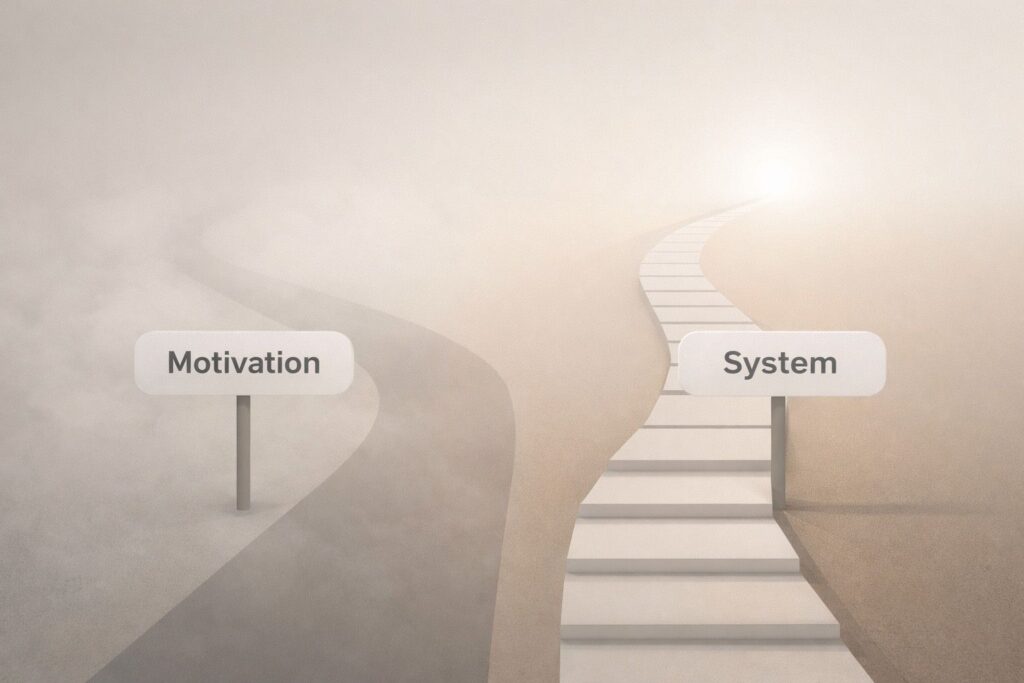
It was about System vs Motivation.
And I had been building my life on the wrong foundation.
Why “System vs Motivation” Changed Everything for Me
Motivation feels powerful.
It makes you design color-coded plans at midnight.
It makes you promise yourself that this year will be different.
It makes you believe energy will last forever.
But motivation is emotional.
And emotions are unstable.
The System vs Motivation shift is simple:
- Motivation depends on mood.
- A system works even when you don’t feel like it.
When I understood this, I stopped asking:
“How do I stay motivated?”
And started asking:
“What supports me when I’m tired?”
That question changed everything.
The Hidden Reason We Keep Restarting Our Lives
Most people don’t fail because they’re lazy.
They fail because their habits are built on temporary energy.
Research in behavioral psychology consistently shows that environment and structure drive behavior more than willpower (see findings discussed by https://jamesclear.com/atomic-habits).
Yet we keep trying harder instead of designing smarter.
Here’s what my old routine looked like:
- Big weekly goals
- No daily structure
- Emotional self-talk
- All-or-nothing mindset
One bad day destroyed the whole plan.
Because there was no system to catch me.
That’s the danger of ignoring the System vs Motivation principle.
The Simple Productivity Systems That Finally Stuck
When I stopped trying to “be better” and started building productivity systems, things became lighter.
Here’s what actually worked:
1. Fewer Decisions
I pre-decided:
- Writing hours
- Workout time
- Content schedule
No daily negotiation with myself.
2. Minimum Baselines
Instead of “write 1,000 words,” I committed to:
- 200 words minimum.
Small enough to do on bad days.
Big enough to build momentum.
3. Environment Over Emotion
I stopped relying on hype videos.
I redesigned my desk.
Removed distractions.
Prepared tomorrow’s task at night.
Environment > motivation.
Behavioral studies from sources like https://www.apa.org confirm that structured environments significantly improve consistency.
This was the real System vs Motivation breakthrough.
What Happens When You Design for Tired Days
The real test of consistency isn’t a productive Monday.
It’s a draining Thursday.
When I built systems assuming I would feel tired, distracted, or emotional — everything changed.
Because now:
- Missing one day didn’t destroy the week.
- Low energy didn’t mean zero output.
- Progress became boring… and stable.
And boring is powerful.
“Consistency isn’t dramatic. It’s quiet.”
That’s something I wish I understood earlier.
The goal isn’t to feel inspired every day.
The goal is to keep moving when inspiration disappears.
That’s the essence of System vs Motivation.
A Quiet Shift That Saved My Consistency
People sometimes ask me what changed in me.
Honestly?
Nothing.
I’m still enthusiastic. Still emotional. Still ambitious.
But now I don’t depend on those feelings.
My life doesn’t restart every Monday anymore.
It flows.
Because instead of asking for more motivation, I built more support.
And that’s the difference no one talks about.
Before You Leave — Read These to Go Deeper
If this breakdown of the India AI Summit 2026 controversy shifted how you think about AI, optics, and national innovation narratives, don’t stop here.
Sustainable growth — whether in technology, income, or investing — comes from combining skills, systems, and timing.
I’ve broken those ideas down across these in-depth guides: