


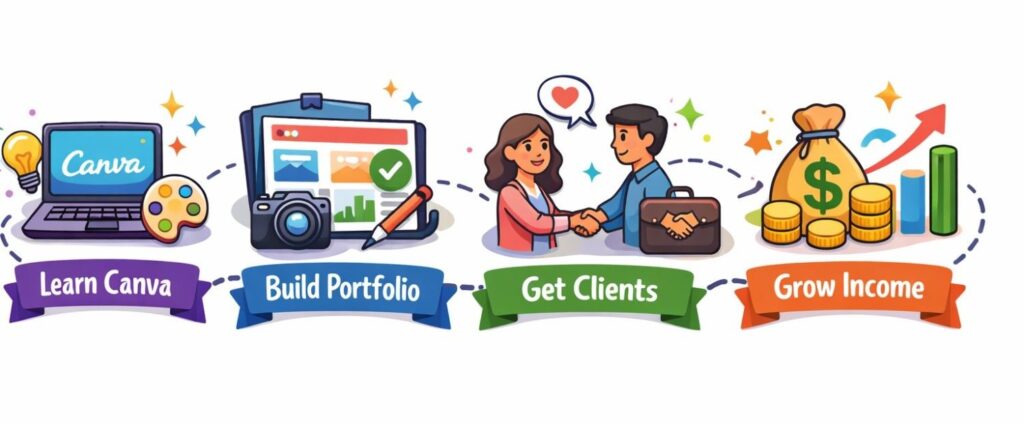
Canva isn’t just a tool — it’s an income machine.
Thank you for reading this post, don't forget to subscribe!Table of Contents
1. Why Canva Changed Everything for Me (And Why I Was Skeptical at First)
When people talk about earning money online, Canva is rarely taken seriously. It’s often dismissed as a “beginner tool” — something used for fun Instagram posts, school presentations, or quick flyers. I believed the same thing for a long time, never imagining that this Canva side hustle would later become the exact path behind how I earned $1800. Back then, the idea of making money using Canva sounded unrealistic, almost laughable — until real results forced me to rethink everything.
I didn’t think Canva could generate real income, let alone consistent income.
At the time, I wasn’t chasing luxury or overnight success. I simply wanted independence. I didn’t want to depend on a traditional job, and I didn’t want to wait years before seeing results. I also didn’t have a design degree, an agency background, or a powerful laptop.
What I did have was time, curiosity, and a strong desire to figure something out.
The idea that Canva could eventually help me earn $1800 over 7 months wasn’t even on my radar. In fact, if someone had told me that upfront, I probably would’ve laughed. Canva felt too simple. Too basic. Too crowded.
But that assumption turned out to be wrong — and that misunderstanding is exactly why most people never earn money with Canva.
The truth is, Canva doesn’t fail people. People fail Canva by using it without strategy.
And that’s what this story is really about.
2. The Early Failure That Quietly Prepared Me for Canva Income
Before Canva ever paid me a single dollar, I failed at something else.
I tried launching a small digital product project with a friend. We didn’t have funding, mentors, or much experience. We relied on trial, error, and small daily investments. I handled visuals. My friend handled promotion.
The results were inconsistent. Some days showed promise. Other days wiped out progress completely. Eventually, we hit a wall — not because the idea was terrible, but because we ran out of resources.
On the surface, it felt like wasted effort.
But that phase taught me three things that later became critical:
- Design matters more than people admit
- Online attention is expensive but powerful
- Skill compounds faster than money
I didn’t realize it then, but that failure quietly trained me to respect design as a business asset — not just decoration.
That mindset shift is what made Canva click later.
3. Discovering Canva as an Income Tool, Not Just a Design App
The moment that changed everything wasn’t dramatic.
I was casually scrolling social media when I saw a creator designing a simple post in Canva — nothing complex, nothing fancy. But what caught my attention wasn’t the design. It was the context.
She wasn’t designing for fun.
She was designing for a client.
That single detail flipped a switch in my head.
I already knew Canva basics. I had used it casually. But I had never once thought of it as a service-based skill. I assumed “real designers” used complicated software, worked for agencies, or had degrees.
That assumption was wrong.
Clients don’t pay for software mastery.
They pay for solutions.
That realization turned Canva from a hobby into a possibility.

4. Why Most People Fail to Earn Money with Canva
Here’s an uncomfortable truth:
Most people who try to earn money with Canva never fail because they’re bad at Canva.
They fail because they:
- Copy templates without understanding design logic
- Post randomly without positioning
- Chase money before building credibility
- Expect clients without visibility
Canva is not a magic button. It’s leverage.
If you treat Canva like a shortcut, it will disappoint you. If you treat it like a skill platform, it will surprise you.
Once I accepted that, I stopped asking:
“How can I make money quickly?”
And started asking:
“How can I become useful with Canva?”
That single shift changed everything.
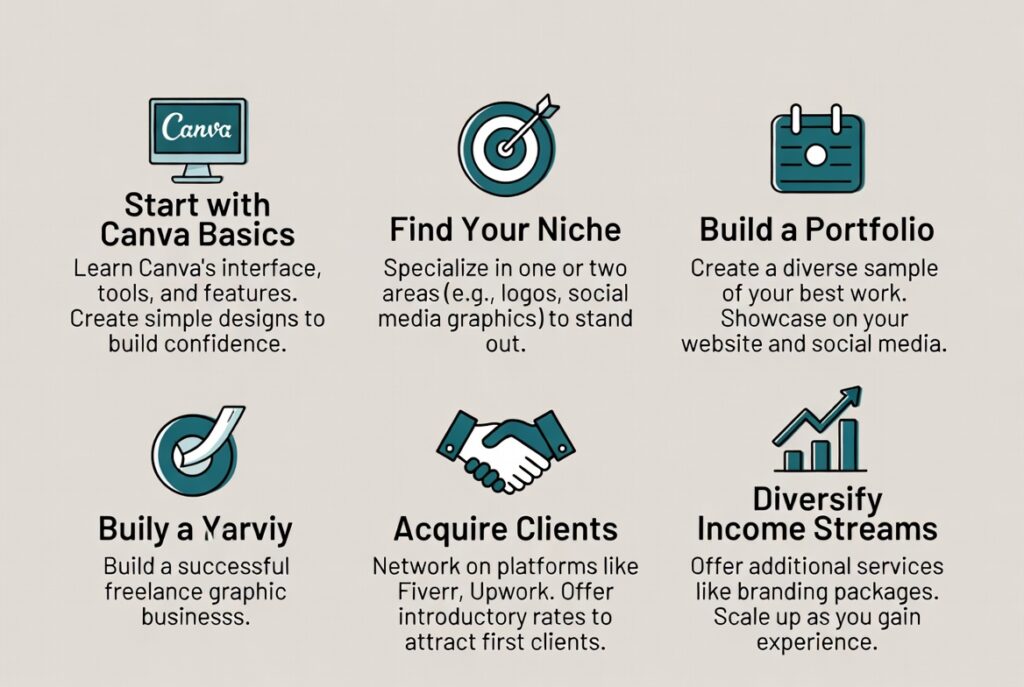
5. Choosing the Right Canva Niche (This Decision Matters More Than Skill)
One of the biggest mistakes beginners make is trying to design everything.
Logos, thumbnails, posts, banners, presentations — all at once.
That approach kills progress.
I forced myself to choose one niche where Canva already had demand. I didn’t choose based on passion. I chose based on:
- Repetition
- Demand
- Clear outcomes
Social media design made sense.
Small brands don’t need perfection. They need consistency. They need speed. They need affordability. Canva fits that gap perfectly.
Once I committed to a niche, learning became faster. My designs improved because I was solving the same problem repeatedly.
Niche brings clarity.
Clarity brings confidence.
Confidence attracts clients.
6. Learning Design the Right Way (Without Overwhelm or Burnout)
Design isn’t about talent. It’s about structure.
Instead of watching random tutorials, I focused on:
- Alignment
- Spacing
- Typography hierarchy
- Color balance
Canva already handles the technical side. What matters is decision-making.
Once I understood why a design works, templates stopped controlling me. I started controlling them.
This phase wasn’t exciting. It was slow. Sometimes frustrating. But it was necessary.
Because clients don’t pay for Canva access.
They pay for design judgment.
7. Building a Canva Portfolio That Actually Converts Clients
A portfolio isn’t about showing everything you’ve done.
It’s about showing what clients want to buy.
I created mock designs for imaginary brands. Not random designs — but designs that solved specific problems:
- Promotional posts
- Informational slides
- Engagement-focused visuals
I presented them cleanly and consistently.
No website. No fancy tools. Just Canva.
The goal wasn’t perfection.
The goal was clarity.
Clients don’t want options. They want confidence.
8. How I Started Getting Clients Without Cold Pitching
I didn’t message hundreds of people.
Instead, I posted consistently.
That’s it.
When your work is visible, you don’t chase clients — you filter them.
Over time, inquiries started coming in. Slowly at first. Then regularly.
Visibility compounds. Silence doesn’t.
9. Pricing Canva Work Without Undervaluing Yourself
Pricing scared me more than design.
I learned one rule quickly:
Never price from fear.
Start higher than your comfort zone. Let negotiation bring you to fair value.
Clients respect clarity more than cheap rates.
That mindset alone added hundreds of dollars over time.
10. Turning Canva Skills into Multiple Income Streams
Client work was just the foundation.
Once trust was built, opportunities expanded:
- Digital resources
- Canva access guidance
- Live teaching
Each stream reinforced the others.
That’s how Canva stopped being “freelance work” and became income infrastructure.
11. Scaling from Small Payments to Consistent Monthly Income
The jump wasn’t sudden.
It was boring.
Predictable.
Repeatable.
And that’s exactly why it worked.
Consistency beats intensity every time.
12. Mistakes That Cost Me Time, Money, and Confidence
I undercharged.
I overworked.
I compared too much.
Every mistake taught me what not to do next.
Progress isn’t clean. It’s cumulative.
13. The Reality of Canva Income (No Fake Promises)
Canva won’t make you rich overnight.
But it can make you independent faster than most skills if you treat it seriously.
$1800 in 7 months wasn’t luck.
It was alignment.
14. How Beginners Can Start Earning with Canva Today
Start small.
Stay focused.
Build visibility.
Learn design logic.
Solve real problems.
That’s it.
15. Final Thoughts: Why Canva Isn’t Just a Tool — It’s an Income Machine
Canva didn’t change my life.
Using it intentionally did.
And that’s the honest truth.
12. FAQ SECTION
Q1. Can beginners really earn money with Canva?
Yes. Canva removes technical barriers, allowing beginners to focus on design fundamentals and problem-solving.
Q2. How long does it take to earn money with Canva?
With consistent effort, many see results within 3–6 months, depending on niche and visibility.
Q3. Do I need Canva Pro to earn money with Canva?
Not initially, but Canva Pro significantly improves workflow and efficiency.
Q4. Is Canva freelancing sustainable long term?
Yes, especially when combined with multiple income streams beyond client work.
Q5. What is the best niche to earn money with Canva?
Social media design, presentations, and thumbnails have consistent demand.
Before You Leave — Read These to Go Deeper
If this Canva journey shifted how you think about online income, don’t stop at just one method. Sustainable income is built by combining skills, systems, and smart timing—and I’ve broken those pieces down in detail across my other articles.
If you want to understand how a one-person income system can actually work in 2026, especially by using AI video tools and short-form content, this guide walks through the entire framework step by step:
👉 https://technichepro.com/one-person-income-system-in-2026-ai-video-generator/
If your goal is something more immediate and practical, this breakdown shows real ways to make $50 a day online without chasing shortcuts or false promises:
👉 https://technichepro.com/make-50-a-day-online/
To stay ahead of bigger money decisions, trends, and policy impacts, this analysis explains the Union Budget 2026 winners and losers and what it could mean for the stock market and everyday earners:
👉 https://technichepro.com/union-budget-2026-winners-losers-stock-market/
For more no-hype, actionable content on money, finance, online income, and digital opportunities, explore the full collection here:
👉 https://technichepro.com/category/money-finance/
Read strategically. Learn continuously.
The right idea at the right time can change everything.