

The Day My Heart Forced Me to Pay Attention
Table of Contents
I still remember the exact moment.
I was climbing a flight of stairs I had climbed a thousand times before. Halfway up, my chest tightened. Not sharp pain. Just pressure. My breathing felt heavier than it should have. My pulse was racing — but not in the normal “I’m out of shape” way.
It was different.
That was the first time I truly noticed my heart health signs.
Until then, I had treated my body like a machine that would just keep running. Late nights. High stress. Caffeine overload. Minimal sleep. “I’m still young,” I told myself.
But your heart keeps score.
And it tells the truth long before lab results do.
The Subtle Heart Health Signs I Ignored for Years
Looking back, my body had been warning me for months.
- Frequent fatigue I blamed on work
- Resting heart rate slowly creeping upward
- Shortness of breath during simple tasks
- Occasional dizziness
- Heart pounding after minor stress
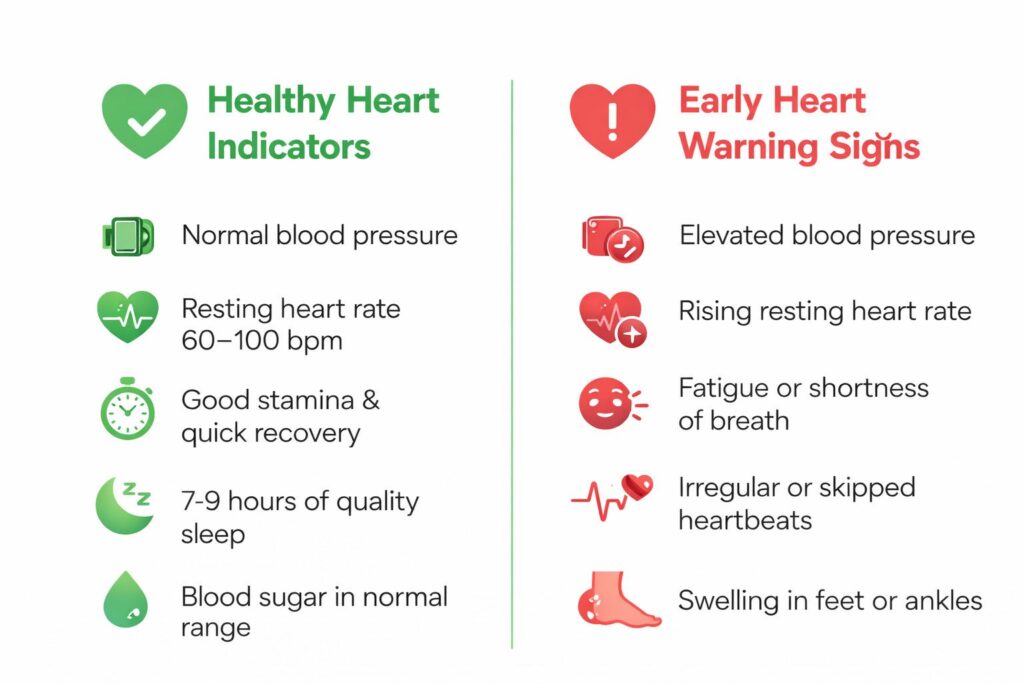
These are early heart warning signs many people dismiss.
According to the American Heart Association’s Life’s Essential 8 (https://www.heart.org/en/healthy-living/healthy-lifestyle/lifes-essential-8), heart health is deeply connected to sleep, stress, blood pressure, cholesterol, blood sugar, and physical activity.
I wasn’t failing in one area.
I was failing in five.
And my heart health signs were reflecting that imbalance.
When Stress Spoke Louder Than My Stethoscope
There was another incident that shook me.
I was in a meeting — completely normal day — when I felt my heartbeat pounding in my ears. My smartwatch showed 118 bpm… while sitting.
No exercise.
No emergency.
Just stress.
Chronic stress increases cortisol and adrenaline. Over time, that constant activation impacts blood pressure, heart rhythm, and arterial health.
The National Heart, Lung, and Blood Institute emphasizes knowing your numbers — blood pressure, cholesterol, blood sugar (https://www.nhlbi.nih.gov/news/2023/numbers-know-healthy-heart). I didn’t know mine.
That ignorance was my biggest risk factor.
Your heart health signs often reflect your mental state before your mind admits it.
8 Powerful Heart Health Signs You Should Never Overlook
Here are the heart health signs I now take seriously — and you should too.
1. Resting Heart Rate Changes
Normal range: 60–100 bpm.
But trends matter more than a single reading.
If your resting heart rate steadily climbs over weeks, your body is under strain.
Mine went from 62 to 78 in one year.
That wasn’t random.
2. Recovery Time After Exercise
A healthy heart recovers quickly.
If your pulse stays elevated long after mild activity, it’s a red flag.
Recovery rate is one of the most overlooked healthy heart indicators.
3. Persistent Fatigue
Constant tiredness can signal reduced oxygen circulation or early cardiovascular strain.
I thought I needed coffee.
I needed lifestyle correction.
4. Shortness of Breath
If walking uphill suddenly feels harder than it used to, pay attention.
Early signs of heart disease often show up during exertion.
5. Irregular Heartbeat
Occasional skipped beats can be normal.
Frequent fluttering?
That deserves medical evaluation.
6. Swelling in Feet or Ankles
Fluid retention can indicate circulation inefficiency.
Many ignore this subtle heart symptom.
7. Chest Discomfort (Even Mild)
Not all cardiac discomfort is dramatic.
Mine felt like pressure, not stabbing pain.
8. Poor Sleep Quality
Sleep apnea and fragmented sleep increase cardiovascular risk.
Poor sleep is one of the strongest heart health signs people overlook.
Healthy Heart Indicators Most People Don’t Track
After my scare, I began tracking the right metrics.
Here’s what changed everything:
| Indicator | Healthy Range | Why It Matters |
|---|---|---|
| Resting Heart Rate | 60–70 bpm (ideal for many adults) | Shows cardiovascular efficiency |
| Blood Pressure | ~120/80 mmHg | High levels damage arteries |
| LDL Cholesterol | Low | Reduces plaque buildup |
| Fasting Blood Sugar | Stable | Prevents vascular damage |
| Sleep Duration | 7–9 hours | Supports heart recovery |
These healthy heart indicators gave me objective clarity.
Numbers remove denial.
Early Heart Warning Signs That Changed My Routine
One evening, I felt lightheaded after standing up quickly. It passed — but it scared me.
I booked a full cardiac checkup.
Results?
- Borderline high blood pressure
- Elevated LDL cholesterol
- Poor stress markers
Nothing “critical.”
But trending wrong.
That’s the danger zone.
Early heart warning signs rarely scream. They whisper.
And if you wait for a scream, you’ve waited too long.
The Science Behind What Your Heart Is Revealing
Your heart reflects:
- Arterial flexibility
- Oxygen efficiency
- Nervous system balance
- Inflammation levels
- Hormonal stress load
Cardiovascular disease remains the leading cause of death globally, according to the World Health Organization.
Many cases are preventable.
Most begin with ignored heart health signs.
Your heartbeat variability, blood pressure patterns, and recovery metrics tell a deeper biological story.
They reveal lifestyle truth.
How I Rebuilt My Heart Health (Step-by-Step Blueprint)
Here’s exactly what I did.
1. I Walked Every Day
30 minutes.
Non-negotiable.
Consistency > intensity.
Within 3 months, my resting heart rate dropped by 8 points.
2. I Reduced Processed Sugar
Sugar impacts inflammation and blood vessels.
After 6 weeks, my energy stabilized.
3. I Fixed My Sleep
No screens 1 hour before bed.
Cooler room temperature.
Consistent schedule.
Sleep alone improved my heart health signs dramatically.
4. I Learned Stress Regulation
Breathing exercises.
Meditation.
Short mental resets during work.
Stress management is cardiovascular management.
5. I Monitored My Numbers
Monthly blood pressure checks.
Annual lipid panel.
Routine physical exams.
Awareness changed behavior.
The Emotional Side of Heart Health No One Talks About
Here’s something personal.
A close relative of mine ignored mild chest discomfort for months.
He called it “indigestion.”
One morning, it wasn’t.
The heart attack didn’t come from nowhere.
It came from years of small ignored heart health signs.
That incident changed how I see my own symptoms.
We often dismiss signals because we’re busy.
But your heart doesn’t negotiate.
It responds to lifestyle math.
3 Standalone Truths About Your Heart
Your heart reflects your habits, not your intentions.
Stress is not just mental — it is cardiovascular.
Prevention feels boring… until crisis makes it urgent.
What To Do Now — Before Your Heart Has to Shout
If you’ve read this far, don’t ignore the nudge.
Here’s your immediate action plan:
- Check your resting heart rate tomorrow morning.
- Measure your blood pressure this week.
- Evaluate your sleep honestly.
- Schedule a physical if it’s been over a year.
- Start 20–30 minutes of movement daily.
Don’t wait for dramatic symptoms.
Heart health signs show up quietly first.
Listen now — so you never have to hear them scream.
11) FAQ Section (H5)
1. What are the most common heart health signs to watch for?
Common heart health signs include persistent fatigue, shortness of breath, irregular heartbeat, mild chest discomfort, and rising resting heart rate. These early indicators often appear before serious symptoms develop.
2. Can heart health signs appear even if I feel generally healthy?
Yes. Many early heart warning signs are subtle and easy to dismiss. Feeling “fine” does not mean your cardiovascular system is functioning optimally.
3. How do I know if my resting heart rate is unhealthy?
If your resting heart rate steadily increases over time or consistently stays above normal ranges without explanation, it may signal cardiovascular strain or stress imbalance.
4. Are early signs of heart disease reversible?
In many cases, yes. Lifestyle changes such as improved diet, exercise, sleep, and stress management can significantly improve heart health indicators.
5. How often should I check heart health signs like blood pressure?
Adults should check blood pressure at least annually, or more frequently if they have risk factors. Regular monitoring helps detect trends early.
6. Can stress alone cause heart health signs to worsen?
Absolutely. Chronic stress increases blood pressure, inflammation, and heart rate variability changes — all of which impact long-term cardiovascular health.
7. What is the difference between healthy heart indicators and warning signs?
Healthy heart indicators show efficient recovery, stable blood pressure, and good stamina. Warning signs include persistent discomfort, fatigue, irregular rhythms, and abnormal test results.
8. When should I see a doctor about heart symptoms you shouldn’t ignore?
Seek medical attention immediately for severe chest pain, shortness of breath, fainting, or radiating pain. For persistent mild symptoms, schedule a professional evaluation promptly.
External resources
- American Heart Association — Life’s Essential 8
https://www.heart.org/en/healthy-living/healthy-lifestyle/lifes-essential-8 - National Heart, Lung, and Blood Institute (NIH) — Know Your Heart Numbers
https://www.nhlbi.nih.gov/heart-truth/know-and-control-your-heart-health-numbers - World Health Organization — Cardiovascular Diseases (CVDs) Fact Sheet
https://www.who.int/news-room/fact-sheets/detail/cardiovascular-diseases-(cvds) - Centers for Disease Control and Prevention (CDC) — Heart Disease Facts
https://www.cdc.gov/heart-disease/data-research/facts-stats/index.html - Mayo Clinic — Heart Disease Symptoms & Causes
https://www.mayoclinic.org/diseases-conditions/heart-disease/symptoms-causes/syc-20353118