

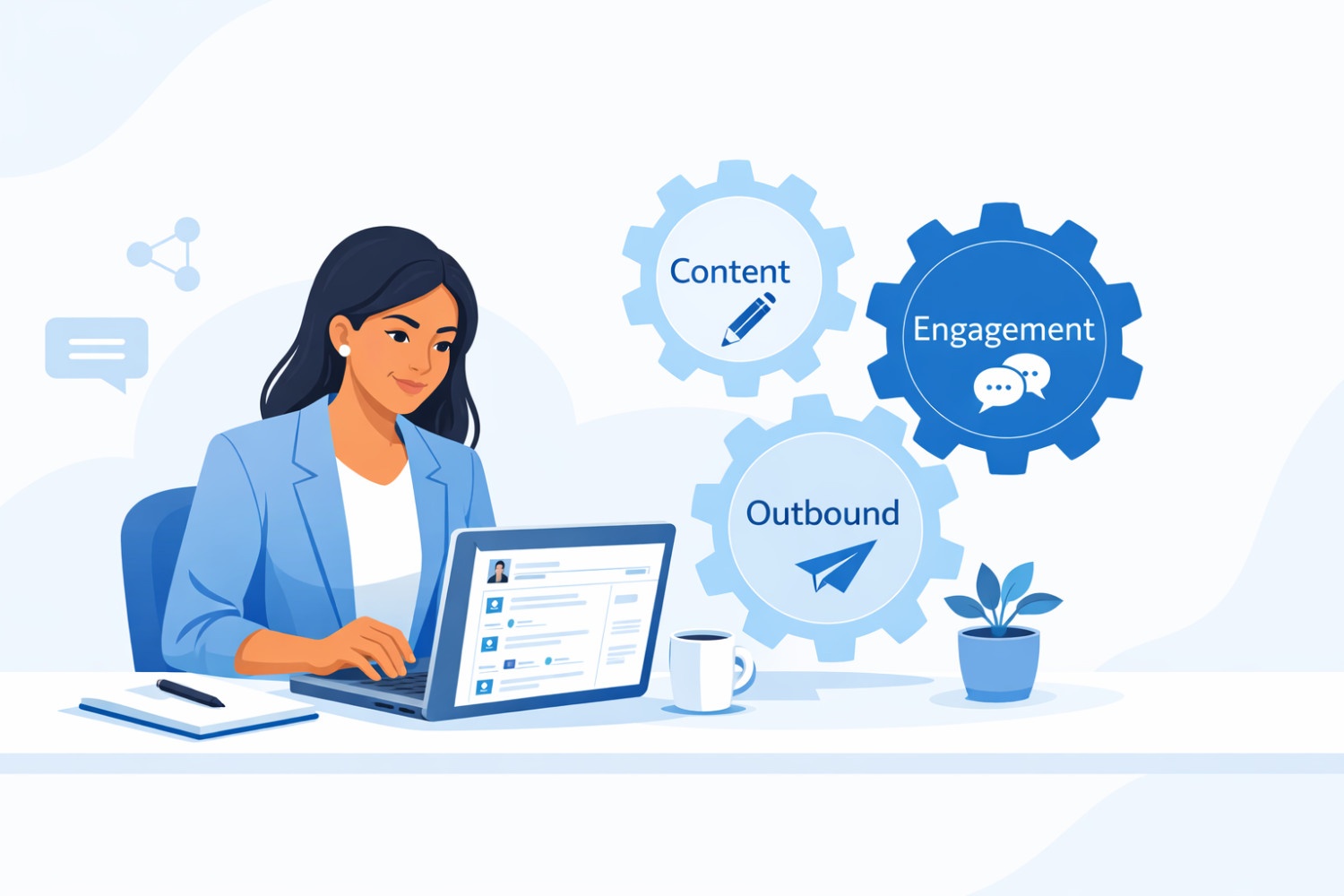
Make LinkedIn predictable—then make it profitable
Table of Contents
I used to treat LinkedIn like a “when I feel like it” app.
You know the vibe: I’d open my laptop, think today I’ll post something powerful, then spend 40 minutes overthinking a hook… and finally close the tab because life happened.
A client call ran long.
My energy dipped.
Dinner needed to be made.
And suddenly, it was “I’ll post tomorrow.”
Tomorrow became next week.
And LinkedIn became that one place where everyone else looked consistent… while I looked like I couldn’t decide what I stood for.
That inconsistency cost me more than likes.
It cost me momentum.
And here’s the part I don’t love admitting: I blamed the algorithm instead of my lack of a system.
If you’re reading this and thinking, “Same,” I’m writing this for you.
Because I’m Shrishati Singh—25, building my career and business in real time—and the biggest lesson I learned is simple:
LinkedIn rewards systems, not moods.
And once I built a simple LinkedIn system, I stopped relying on inspiration and started building predictable $9K months.
The “Random Posting” Era That Quietly Kept Me Stuck
There was a season where I was doing “everything right” on paper:-
- Posting tips
- Sharing lessons
- Trying to sound smart
- Watching other creators for ideas
But it still felt like pushing a car uphill.
I’d post and disappear.
I’d get a few likes and feel good for five minutes.
Then I’d check my inbox and see… nothing.
No conversations.
No leads.
No real opportunities.
One evening, I remember sitting on my bed, laptop open, and thinking:
“What’s the point if I’m doing all this and nothing changes?”
That moment wasn’t dramatic. No movie soundtrack.
Just quiet frustration.
And that’s exactly why most people quit—they don’t quit loudly. They quit silently.
Why a Simple LinkedIn System Beats Motivation Every Time
Motivation is cute until your week gets real.
A system doesn’t care if:
- you’re tired
- your day is messy
- your confidence is low
- your post “doesn’t feel perfect”
A system just runs.
And when LinkedIn becomes predictable, income becomes predictable.
That’s the real game.
Not “how do I go viral?”
But:
“How do I build trust and create demand every week?”
The 3-Cog Framework That Powers My Simple LinkedIn System
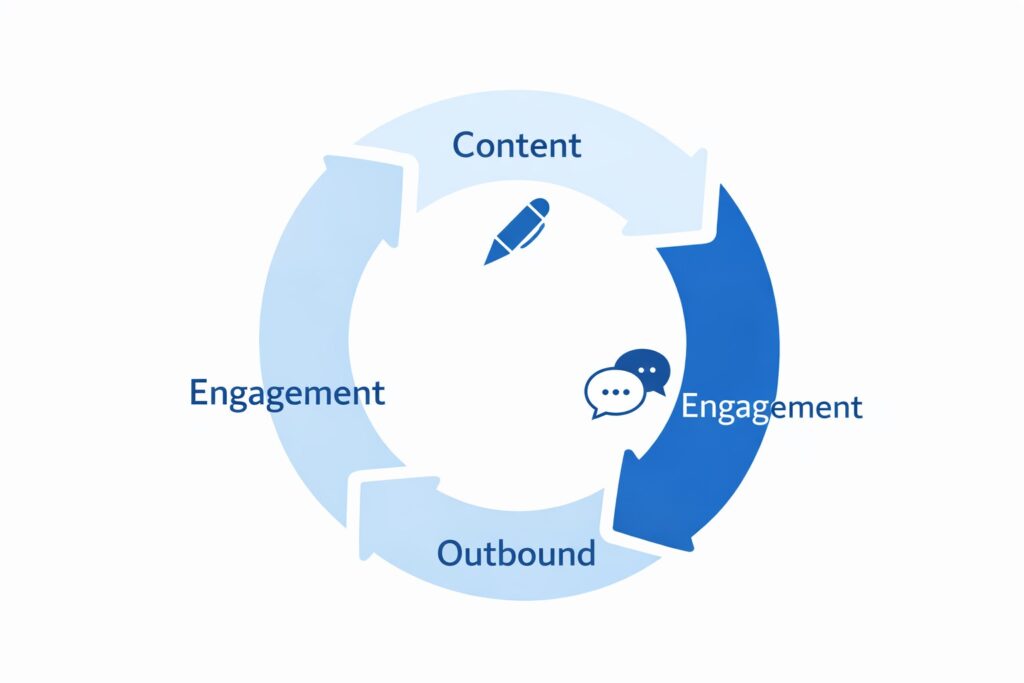
Here’s the simple LinkedIn system that holds everything together:
1) Content
Content builds trust.
2) Engagement
Engagement builds visibility.
3) Outbound
Outbound builds control.
If one cog breaks, your whole machine slows down.
If all three run, your results stop feeling random.
Shareable line #1:
Virality is luck. Systems are leverage.
My Content Rules That Build Trust Without Burning Me Out
I used to obsess over posting frequency.
Now I obsess over consistency.
My rules:
- 3–5 posts per week (no more, no less)
- Post when I can engage right after
- Engage 15–30 minutes before posting
- Engage 15–30 minutes after posting
That’s it.
Not because I’m lazy—because I’m strategic.
My goal isn’t to be a full-time creator.
My goal is to build a pipeline.
The Idea Capture Trick That Stopped My “Blank Page” Days
The hardest part isn’t writing.
It’s starting.
For me, ideas used to disappear like this:
I’d have a great thought during a walk…
then forget it by the time I opened Notes.
So I built an “idea capture” habit.
Here are my 5 idea sources:
- Steal from myself
I look at older posts that worked and reframe them with a new angle. - Steal like an artist
I borrow themes from others, then add my story + opinion. - Educate my past self
“What would 2024 Shrishati have needed to hear?” - Curation + commentary
I share a lesson from a book/podcast and add my POV. - FAQ content
If people ask me the same thing twice, it becomes a post.
The secret is not “having ideas.”
It’s training your brain to notice them.
Shareable line #2:
Everything that frustrates you today is content for someone tomorrow.
4 Tiny Tweaks That Turn Posts Into Inbound Leads
You can post consistently and still attract the wrong audience.
These are the tweaks that changed my results:
1) Formatting is a growth hack
Short lines.
White space.
Bullets.
People don’t read posts—they scan them.
2) Tie trends back to your expertise
Trends give you reach.
Your expertise gives you relevance.
3) Always add a clear CTA
Not “DM me.”
But something human like:
- “Want my template? Comment ‘SYSTEM’ and I’ll share it.”
- “If you’re building this too, tell me your niche.”
4) Batch your content
One calm writing session beats five rushed ones.
I write in batches when my brain feels clean—usually one weekend morning with chai and zero notifications.
The Engagement System Most People Skip (And Pay For Later)
Most people think content is the whole game.
It’s not.
If you post and disappear, LinkedIn treats you like a billboard—not a person.
My engagement system has two parts:
Part A: Engage on others’ posts (before mine)
I keep a list of 20 people and split them into:
- Big accounts (my audience hangs out there)
- Peers (same stage as me)
- Prospects (people I want to work with)
I add value in their comments—real value.
Not “great post.”
More like:
- an example
- a counterpoint
- a mini-framework
- a short story
Because their comment section is also my visibility.
Part B: Engage on my own post (after posting)
If someone comments, I respond.
Even if it’s short.
People come back when they feel seen.
That’s not manipulation—it’s human.
The Reciprocity Habit That Makes People Come Back
Reciprocity is real.
When you consistently show up for others, they start showing up for you.
Not always instantly. But it compounds.
And compounding is how you build a name without shouting.
Shareable line #3:
Attention isn’t earned by posting more—it’s earned by showing up more.
Outbound Without Being Cringey: My Daily DM Rhythm
For a long time, I avoided outbound because I didn’t want to feel “salesy.”
But here’s the truth:
Inbound is amazing… until it’s slow.
Outbound gives you stability.
My outbound rhythm:
- 20 new connections per day
- Start 10–20 conversations per day
- 1 hour in DMs daily (like the gym—non-negotiable)
And no, I’m not pitching in the first message.
I start like a normal person.
Examples:
- “Hey, I liked your post on __. Curious—are you focusing more on __ or __ this quarter?”
- “Quick question—what are you building right now on LinkedIn?”
Conversations first. Offers later.
The 3 Outbound Rules That Protect Your Confidence
1) Track your metrics
If you don’t track:
- connection accept rate
- reply rate
- follow-up count
…you’ll feel like it’s “not working” when it’s just unmeasured.
2) Follow up like you mean it
Silence is not rejection.
It’s just… silence.
I follow up politely.
Because most people are busy, not rude.
3) Keep a simple prospect log
Name, niche, context, last message, next follow-up date.
That’s it.
You don’t need a fancy CRM to be consistent.
My Weekly LinkedIn Schedule (Copy/Paste)
Here’s what my week looks like:
Monday: Post + engagement + outbound
Tuesday: Engagement + outbound
Wednesday: Post + engagement + outbound
Thursday: Engagement + outbound
Friday: Post + engagement + outbound
Saturday: Batch content (optional) + light outbound
Sunday: Rest (or idea capture only)
Simple. Repeatable. Predictable.
And that’s exactly why it works.
The One Mindset Shift That Makes $9K Months Inevitable
When I stopped asking:
“What should I post?”
…and started asking:
“What system can I run this week?”
Everything got easier.
Because systems remove decision fatigue.
And decision fatigue is the silent killer of consistency.
If you want $9K months, don’t chase motivation.
Chase predictability.
And if you build this simple LinkedIn system, you won’t just grow your profile.
You’ll grow your confidence.
Because nothing feels better than knowing:
You’re not hoping anymore. You’re executing.
External resources (DoFollow)
Robert Cialdini’s work on reciprocity (Influence): https://www.influenceatwork.com/principles-of-persuasion/
LinkedIn help docs on engagement basics and best practices: https://www.linkedin.com/help/linkedin/