

The hidden clues your doctor might be missing — and what to do now
Table of Contents
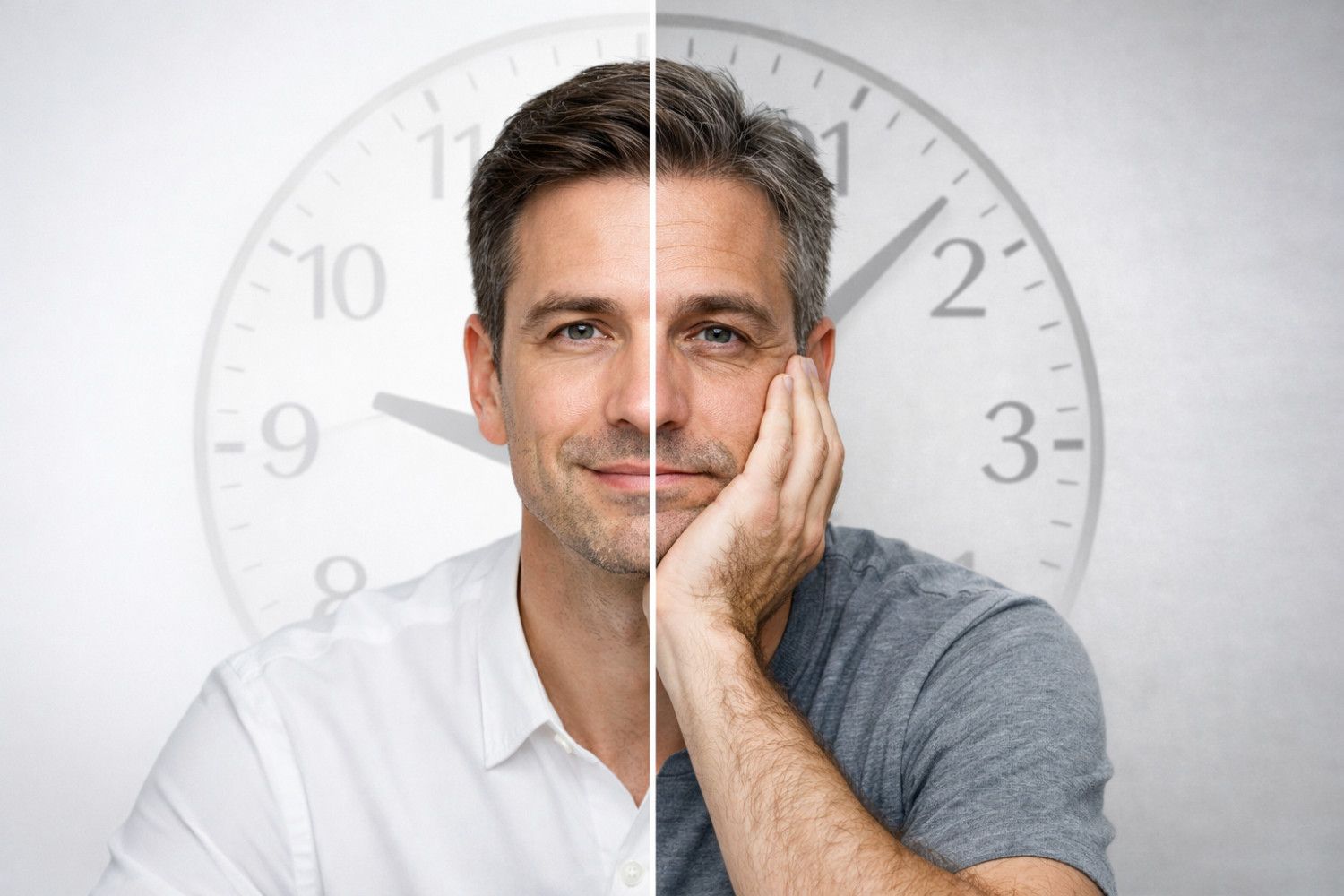
I used to believe aging was obvious.
Wrinkles. Gray hair. Slower mornings.
But what if I told you the most dangerous aging doesn’t show up in the mirror?
It shows up in your energy.
Your sleep.
Your recovery.
Your mood.
And by the time you notice something is wrong… it’s already been happening for years.
This isn’t theory.
This is my story.
The Day I Realized Something Was Wrong
I was 34 when I first felt it.
Not old. Not even close.
But something wasn’t right.
I was waking up exhausted — even after 7–8 hours of sleep. My workouts felt heavier. My brain felt slower. I needed coffee not for productivity, but survival.
I remember one specific incident.
I was climbing a small flight of stairs — something I’d done thousands of times — and my legs felt unusually heavy. Not sore. Not injured. Just… tired.
I laughed it off.
“Guess I’m getting older.”
But deep down, I knew that wasn’t normal.
That was the first silent warning sign.
Chronological Age vs. Biological Age: The Truth I Ignored
Here’s what I didn’t understand back then:
Your chronological age is how many years you’ve been alive.
Your biological age is how old your body actually functions.
And they are not always the same.
You can be 35 chronologically…
And 45 biologically.
Accelerated aging happens when:
- Chronic inflammation stays high
- Stress hormones never shut off
- Blood sugar swings constantly
- Sleep quality drops
- Muscle mass quietly declines
None of this shows up overnight.
It builds silently.
And that’s exactly what happened to me.
The Silent Warning Signs I Dismissed for Years
Looking back, the clues were obvious.
At the time, they felt “normal.”
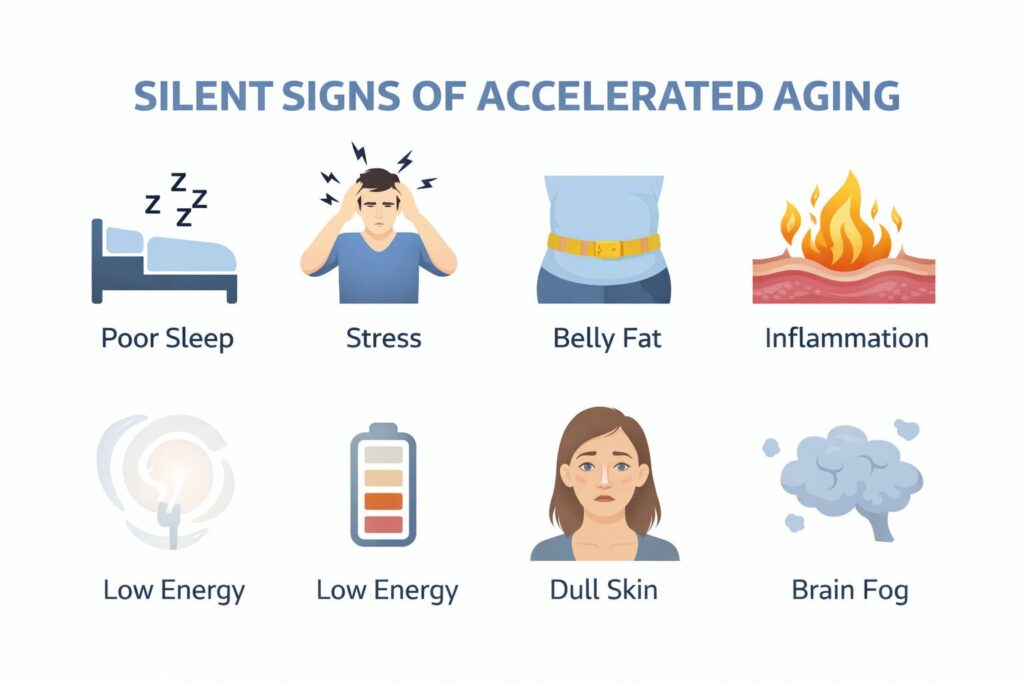
Here’s what I ignored:
1. Constant Low-Level Fatigue
Not extreme exhaustion. Just a baseline of 70% energy — never 100%.
2. Brain Fog
I’d reread the same email twice. Names slipped. Words didn’t come quickly.
3. Belly Fat That Wouldn’t Budge
Despite eating “healthy” and exercising.
4. Slower Recovery
Two days to recover from workouts that used to take one.
5. Mood Irritability
Small things triggered disproportionate reactions.
6. Poor Sleep Depth
I was sleeping… but not restoring.
At first, I blamed work stress.
Then I blamed aging.
The truth?
My body was aging faster than it should.
The Doctor Said “You’re Fine” — But I Wasn’t
Here’s the frustrating part.
I went for routine bloodwork.
Everything came back “within range.”
Cholesterol: normal.
Blood sugar: technically normal.
Thyroid: normal.
But “normal” doesn’t mean optimal.
It doesn’t mean resilient.
It doesn’t mean you’re not aging faster beneath the surface.
I remember leaving that appointment feeling relieved… but confused.
If everything was fine — why didn’t I feel fine?
That confusion delayed my wake-up call by another year.
The Incidents That Forced Me to Wake Up
Three moments changed everything.
Incident #1: The Gym Reality Check
I tried to match a workout I had done five years earlier.
Same exercises. Same weights.
I couldn’t finish.
Not because I was injured.
Because I lacked endurance and recovery.
That’s when it hit me — I wasn’t just “out of shape.”
Something deeper had shifted.
Incident #2: The Photo I Didn’t Recognize
A candid photo at a family event.
My face looked puffy. My eyes tired. My posture slightly collapsed.
It didn’t match how I saw myself internally.
That visual shock forced me to admit something wasn’t right.
Incident #3: The Lab Test That Finally Revealed the Truth
I eventually asked for more detailed testing — inflammatory markers, insulin levels, vitamin deficiencies.
That’s when patterns appeared:
- Elevated inflammation
- Borderline insulin resistance
- Low vitamin D
- Elevated cortisol
Nothing catastrophic.
But collectively? A perfect recipe for accelerated aging.
What Was Actually Happening Inside My Body
Here’s what I learned the hard way.
Aging faster isn’t about wrinkles.
It’s about:
- Mitochondrial efficiency declining
- Hormonal rhythms flattening
- Muscle mass decreasing
- Chronic inflammation rising
- Metabolic flexibility shrinking
These changes are subtle.
They don’t scream.
They whisper.
And if you ignore them long enough — they become irreversible.
The 7 Hidden Clues Your Doctor Might Be Missing
Most standard checkups look for disease.
They don’t look for accelerated aging.
Here are the silent clues that matter:
1. High-Normal Fasting Glucose
“Normal” at 99 mg/dL isn’t optimal.
2. Elevated Fasting Insulin
Often not tested — but crucial for metabolic aging.
3. Low Vitamin D
Strongly linked to immune and cellular health.
4. High CRP (Inflammation Marker)
Even slightly elevated levels matter long-term.
5. Declining Grip Strength
A predictor of biological aging and mortality risk.
6. Poor Heart Rate Variability
Chronic stress leaves a measurable imprint.
7. Loss of Lean Muscle Mass
Muscle is anti-aging tissue.
If you’re losing it — you’re aging faster.
Shareable Insight #1
Most people don’t age because of time — they age because of chronic stress and metabolic dysfunction.
The Turning Point: How I Slowed Down Accelerated Aging
I didn’t overhaul my life overnight.
I fixed the fundamentals.
1. I Prioritized Sleep Ruthlessly
No screens late. Consistent bedtime. Dark room.
Within weeks, energy improved.
2. I Lifted Weights 3–4 Times Weekly
Not cardio marathons.
Resistance training rebuilt muscle — and confidence.
3. I Stabilized Blood Sugar
Protein at every meal.
Reduced ultra-processed carbs.
No constant snacking.
4. I Managed Stress Proactively
Breathing work. Walks without my phone.
Saying “no” more often.
5. I Tested — Then Targeted
Instead of guessing, I tracked inflammation and metabolic markers.
Progress became measurable.
Shareable Insight #2
If you don’t protect your muscle, metabolism, and sleep — aging accelerates silently.
What I Do Differently Now (That Actually Works)
Here’s my weekly non-negotiable system:
| Area | What I Do | Why It Matters |
|---|---|---|
| Sleep | 7.5–8 hours nightly | Restores hormones |
| Strength | 3–4 lifting sessions | Preserves muscle mass |
| Protein | 0.7–1g per lb body weight | Prevents muscle loss |
| Walking | 8–10k steps daily | Improves insulin sensitivity |
| Stress | Daily decompression time | Lowers cortisol |
| Labs | Annual deep panel | Track biological aging |
None of this is extreme.
But consistency compounds.
Within 12 months:
- Energy returned
- Belly fat reduced
- Sleep deepened
- Mood stabilized
- Lab markers improved
Most importantly?
I felt younger at 36 than I did at 33.
Shareable Insight #3
Aging is inevitable. Accelerated aging is not.
If You Recognize Yourself in This Story — Read This
If you’re constantly tired…
If your body composition is shifting…
If workouts feel harder than they should…
If brain fog is becoming your baseline…
Don’t wait for a diagnosis.
Don’t wait for disease.
The warning signs are silent — but they are there.
Start with:
- Sleep
- Strength training
- Blood sugar awareness
- Stress reduction
- Advanced lab testing
Small shifts now prevent massive decline later.
I learned that the hard way.
You don’t have to.
FAQ Section
1. What are the early signs of accelerated aging?
Early signs of accelerated aging include chronic fatigue, brain fog, stubborn belly fat, slower workout recovery, poor sleep depth, and increased inflammation markers — even when basic lab tests appear normal.
2. How do I know if my biological age is higher than my chronological age?
You can estimate biological age through advanced lab panels, inflammation markers, insulin levels, muscle mass testing, and lifestyle factors like sleep quality and stress levels.
3. Can accelerated aging be reversed?
While you can’t stop time, many aspects of accelerated aging can be slowed or partially reversed by improving sleep, building muscle, reducing inflammation, stabilizing blood sugar, and managing stress.
4. What causes silent aging symptoms?
Silent aging symptoms are often caused by chronic stress, insulin resistance, poor sleep, hormonal imbalances, inflammation, nutrient deficiencies, and muscle loss.
5. Does stress really make you age faster?
Yes. Chronic stress elevates cortisol, increases inflammation, disrupts sleep, and accelerates biological aging processes at the cellular level.
6. How can I slow aging naturally?
You can slow aging naturally by prioritizing resistance training, eating adequate protein, stabilizing blood sugar, sleeping 7–8 hours nightly, managing stress, and monitoring key health markers.
7. Is feeling tired all the time a sign of aging faster?
Persistent fatigue can be an early sign of accelerated aging, especially when combined with poor recovery, inflammation, and metabolic dysfunction.
External resources (DoFollow)
LinkedIn help docs on engagement basics and best practices: https://www.linkedin.com/help/linkedin/