

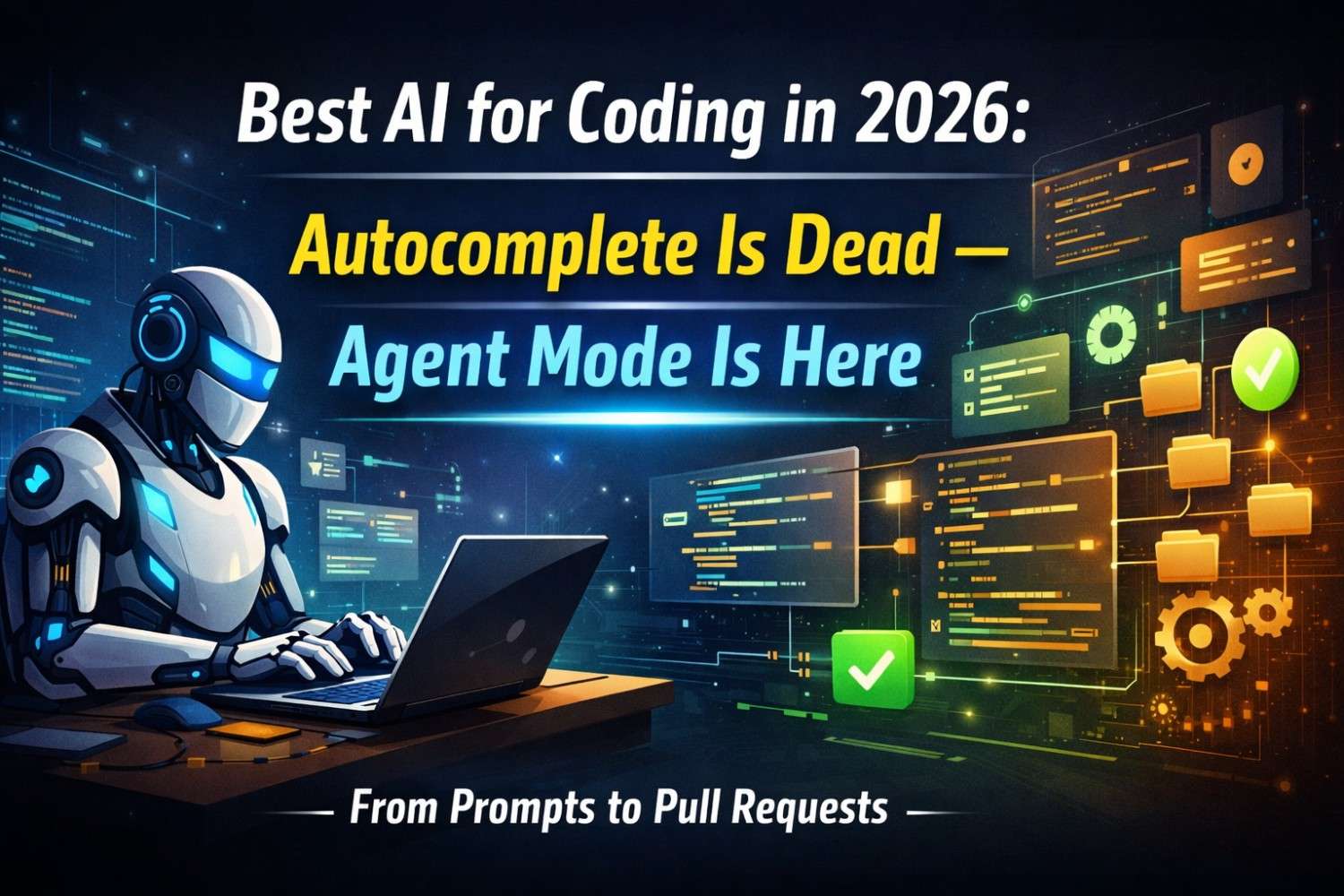
Autocomplete writes lines. Agents ship features across files (and run tests).
Table of Contents
For years, “best AI for coding” meant one thing: faster autocomplete.
You typed a comment, hit Tab, and your editor filled in the next few lines. Nice. Helpful. But still… you were the one doing the real work:
- finding the right files
- understanding the codebase
- wiring modules together
- updating tests
- fixing edge cases
- running commands
- polishing a PR
In 2026, that definition is outdated.
The best AI for coding isn’t the one that completes your line.
It’s the one that can take a goal like:
“Add login with JWT, update routes, write tests, and make sure CI passes.”…and then actually ship the feature across your codebase.
That shift has a name now:
Agent Mode
Agent Mode is the difference between:
- AI code assistant = writes snippets
- AI coding agent = completes multi-step work
This is why “best AI for coding” is exploding: it’s no longer about typing faster.
It’s about shipping faster.
What “Best AI for Coding” Means in 2026
If you search “best AI for coding” today, you’ll see a mix of tools, opinions, and wars in the comments.
But the truth is simpler:
The best AI for coding is the one that fits your job-to-be-done.
In 2026, coding splits into five real tasks people pay for:
- Build features from a spec
- Debug errors and fix bugs
- Refactor safely (without breaking things)
- Write tests (unit + integration)
- Review PRs and explain code
Autocomplete helps with #1 a little.
Agent Mode helps with all five.
That’s why the best AI for coding conversation has changed.
Autocomplete vs Agent Mode (Simple Example)
Let’s make it concrete.
Autocomplete
You: “Create a FastAPI endpoint to upload a file.”
AI: gives you a neat snippet.
Then you still have to:
- decide where it fits
- add routing
- update settings
- add validation
- write tests
- run test suite
- fix anything that fails
Agent Mode
You: “Add a file upload endpoint with validation + tests.”
AI (in agent mode) does something like:
- searches the repo to find the API structure
- finds existing patterns for endpoints
- adds the endpoint in the right module
- updates schema/validators
- writes tests
- runs tests
- fixes failures
- summarizes changes like a PR description
That’s why best AI for coding now means:
Can it work across my codebase? Can it run tools? Can it finish?
The New AI Coding Stack (2026)
If you want a viral, practical take: don’t list 20 tools. Readers bounce.
Instead, explain the stack in one simple model:
Layer 1: AI Code Editor / IDE (where you work)
People now search:
- best AI code editor
- AI code editor 2026
- Cursor vs Copilot
- VS Code AI agent
- JetBrains AI assistant
This is the “home base.”
Layer 2: The Model (brain)
Readers don’t care which model is “smartest.”
They care which one is best AI for coding for their workflow:
- speed
- accuracy
- long context
- tool reliability
- cost
Layer 3: Tools (hands)
This is where Agent Mode gets power:
- run tests
- search codebase
- edit multiple files
- create diffs
- lint + format
- run commands
- open docs in-repo
Without tools, it’s just fancy autocomplete.
Layer 4: Guardrails (safety)
The best AI for coding is useless if it:
- breaks tests
- introduces security bugs
- deletes working code
- hallucinates dependencies
- leaks secrets
Guardrails are what turn “cool demo” into “daily driver.”
The Agent Workflow That Actually Ships Code
Most people fail with AI coding because they do this:
“Build feature X” (one huge prompt)
And the AI responds with:
- random files
- broken assumptions
- partial code
- missing tests
- no commands run
Agent Mode works when you force a simple loop:
Plan → Edit → Test → Fix → Explain
That’s it.
If you want “best AI for coding” results, you need to prompt like a lead engineer.
Here are copy-paste prompts that consistently produce clean work.
Copy-Paste Prompt Pack (Python-Friendly)
1) Repo-Aware Feature Prompt (Agent Mode)
Use this when you want a feature shipped properly.
You are in Agent Mode.

Goal: Add <FEATURE>.

Rules:
- First: scan the repo to find existing patterns and where this should live.
- Make minimal changes that match the current architecture.
- Update / create tests (pytest) for happy path + 2 edge cases.
- Run tests (or simulate the test command you would run) and fix likely failures.
- Output:
  1) Files changed (list)
  2) Patch-style code blocks per file
  3) Test plan + commands
  4) Short PR summary
Keywords naturally included: ai coding agent, agent mode for coding, python ai coding, generate unit tests with ai.
2) Debug Prompt (Stack Trace → Fix)
This is one of the highest-value searches in the “best AI for coding” bucket.
Act like a senior Python debugger.

Input:
- Error stack trace:
<PASTE TRACE>
- Relevant file(s):
<PASTE CODE>

Task:
1) Identify the root cause.
2) Propose the smallest fix.
3) Show the exact patch.
4) Add a test so it never returns.
5) Explain in plain English.
Keywords: ai debugging, fix bugs with ai, python ai coding.
3) Refactor Prompt (Safe + Test-Gated)
Refactoring is where AI usually breaks things. This makes it safe.
Refactor this code safely.

Constraints:
- Behavior must not change.
- Add/extend tests BEFORE refactor.
- Keep function signatures stable unless required.
- Use type hints where helpful.
- After refactor, show:
  - before/after complexity wins
  - test coverage notes
  - any tradeoffs

Code:
<PASTE>
Keywords: refactor with ai, ai for refactoring code, type hints ai.
4) Unit Test Generator (Pytest Done Right)
Most AI-generated tests are shallow. This forces quality.
Write pytest unit tests for this function.

Requirements:
- Cover normal case, boundary case, and failure case.
- Use parameterization where it makes sense.
- Avoid mocking unless necessary.
- Name tests clearly.
- Include at least one test that would have caught a likely bug.

Function:
<PASTE>
Keywords: unit tests with ai, generate pytest with ai.
5) PR Review Prompt (Make It Read Like a Senior Reviewer)
This is underrated and insanely shareable.
Review this diff like a senior engineer.

Focus:
- correctness
- edge cases
- security pitfalls
- performance
- readability
- tests

Output:
- top 5 issues (ranked)
- suggested patch snippets
- what to test manually
- final verdict (approve / request changes)
Keywords: ai code review, PR summary ai, best ai for coding workflow.
The “Best AI for Coding” Scorecard (No Hype)
If you want readers to clap and share, give them a clear scorecard.
When evaluating the best AI for coding in 2026, use these 7 checks:
- Repo Awareness
Can it understand your structure, not a toy example? - Multi-file Editing
Can it update routes, models, tests, and docs together? - Test Behavior
Does it naturally write tests, or do you have to beg? - Tool Use
Can it run commands, format code, and work like an engineer? - Failure Recovery
When tests fail, does it fix intelligently or spiral? - Code Quality
Does it keep style consistent and avoid weird patterns? - Security Hygiene
Does it avoid secrets, unsafe defaults, and dependency hallucinations?
If a tool fails #1–#4, it’s not “best AI for coding.”
It’s autocomplete with marketing.
The Biggest Mistake People Make With AI Coding
They treat the AI like a magic genie.
But the best AI for coding behaves like a junior engineer with super speed:
- it needs clear constraints
- it needs a test gate
- it needs a definition of done
So instead of saying:
“Build authentication”
Say:
“Add JWT auth using our existing middleware pattern, update 3 endpoints, add pytest coverage, and ensure lints pass.”
Agent Mode thrives on clarity.
Autocomplete doesn’t care.
The “Vibe Coding” Trap (And How to Avoid It)
Vibe coding is fun.
It’s also how people ship bugs with confidence.
AI can produce code that looks right while being wrong in subtle ways:
- missing auth checks
- unsafe file handling
- incorrect edge-case logic
- wrong assumptions about state
- dependency confusion
If your post includes this section, it becomes instantly more shareable because it adds a warning + a solution.
Here’s the fix:
The Test Gate Rule
Never accept AI changes without:
- at least one new test
- running the test suite (or the closest equivalent)
- a simple “why this is safe” explanation
The best AI for coding is the one that helps you enforce this.
A Practical “Agent Mode” Example (Python Mini-Scenario)
Let’s say your goal is:
“Add rate limiting to a FastAPI app.”Agent Mode approach:
- Locate middleware pattern
- Add rate limit middleware
- Add config/env variable
- Add tests: allowed + blocked
- Update docs or README snippet
- Run tests
- Summarize changes
Autocomplete approach:
- gives a middleware snippet
- and leaves you with 80% of the work
That difference is the entire 2026 shift.
Final Take
If you remember only one thing:
The best AI for coding in 2026 is not the one that writes code fastest.
It’s the one that finishes work like an engineer: across files, with tests, with fixes.
Autocomplete made you faster at typing.
Agent Mode makes you faster at shipping.
If You Like This Kind of Practical Writing
If you’re building your next version—career, skills, mindset, and execution—I’ve written two books that readers have been using as blueprints:
1) Rebuild: Your next version is only one decision away
A guide to reset your life, rebuild discipline, and future-proof your career in the AI era.
Buy on Amazon:
https://www.amazon.com/dp/B0F9FPXVJQ
2) Retrieval Augmentation Generation: Revolutionizing AI’s Future
A practical, structured guide to RAG—architecture, prompts, real-world use cases, and what’s coming next.
Buy on Amazon:
https://www.amazon.com/dp/B0CTGJS182
And if you want more AI + Python content like this (articles you can actually apply), you’ll find it on my blog:
https://technichepro.comExplore More from Tech Niche Pro
If you enjoyed this deep dive into Hybrid RAG, here are some other high-value guides from Tech Niche Pro that are worth your time:
— Build an AI Agent From Scratch in Python (No LangChain): Tools, Memory, Planning — In One Clean File — https://technichepro.com/build-an-ai-agent-from-scratch-python/
— The Next AI Boom: What’s Coming, Who Wins, and How to Prepare (2026 Edition) — https://technichepro.com/next-ai-boom-2026/
— Choose First AI Product: 10-Step Field Guide to a Useful AI App (2026) — https://technichepro.com/choose-first-ai-product-10-step-field-guide/
— AI Document Extraction: LLMs That Tame Complex PDFs — https://technichepro.com/ai-document-extraction-llms-that-tame-complex-pdfs/
Plus, for more AI trends, Python tutorials, and developer playbooks, browse the full archive at https://technichepro.com/ — your trusted source for real-world AI and tech insights.
These articles will help you extend your Python-AI skills, stay ahead in the AI revolution, and apply cutting-edge techniques to real-world problems.
Bonus resources:
— YouTube ▶️ https://youtu.be/GHy73SBxFLs
— Book ▶️ https://www.amazon.com/dp/B0CKGWZ8JT
Let’s Connect
Email: krtarunsingh@gmail.com
LinkedIn: Tarun Singh
GitHub: github.com/krtarunsingh
Buy Me a Coffee: https://buymeacoffee.com/krtarunsingh
YouTube: @tarunaihacks
👉 If you found value here, like, share, and leave a comment —i t helps more devs discover practical guides like this.