

From tax reforms to capex push — how Budget 2026 reshapes Dalal Street
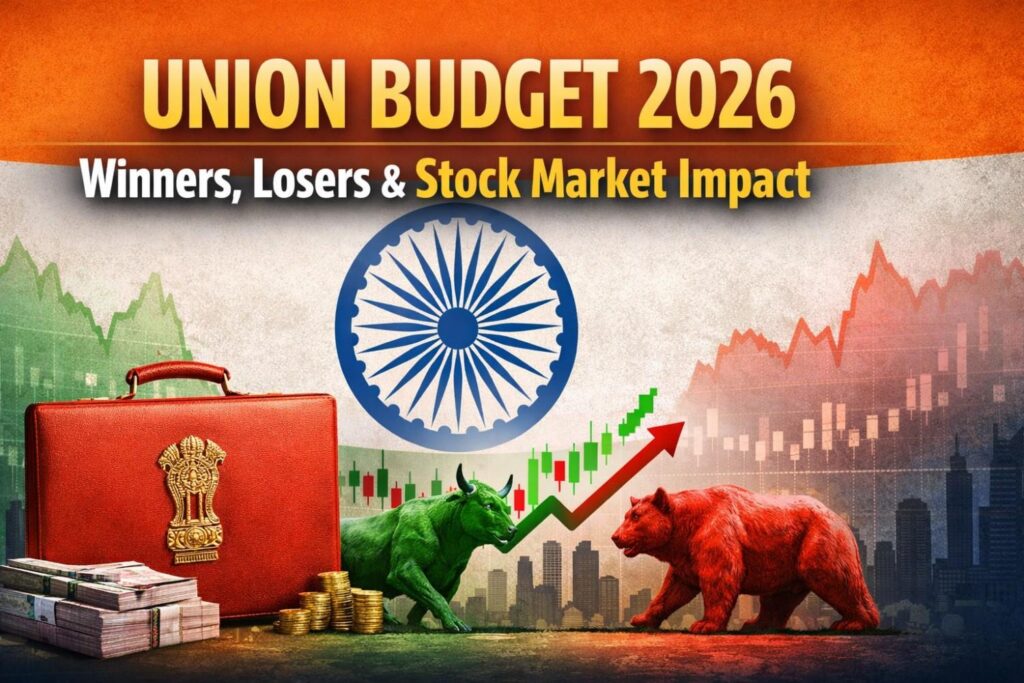
Table of Contents
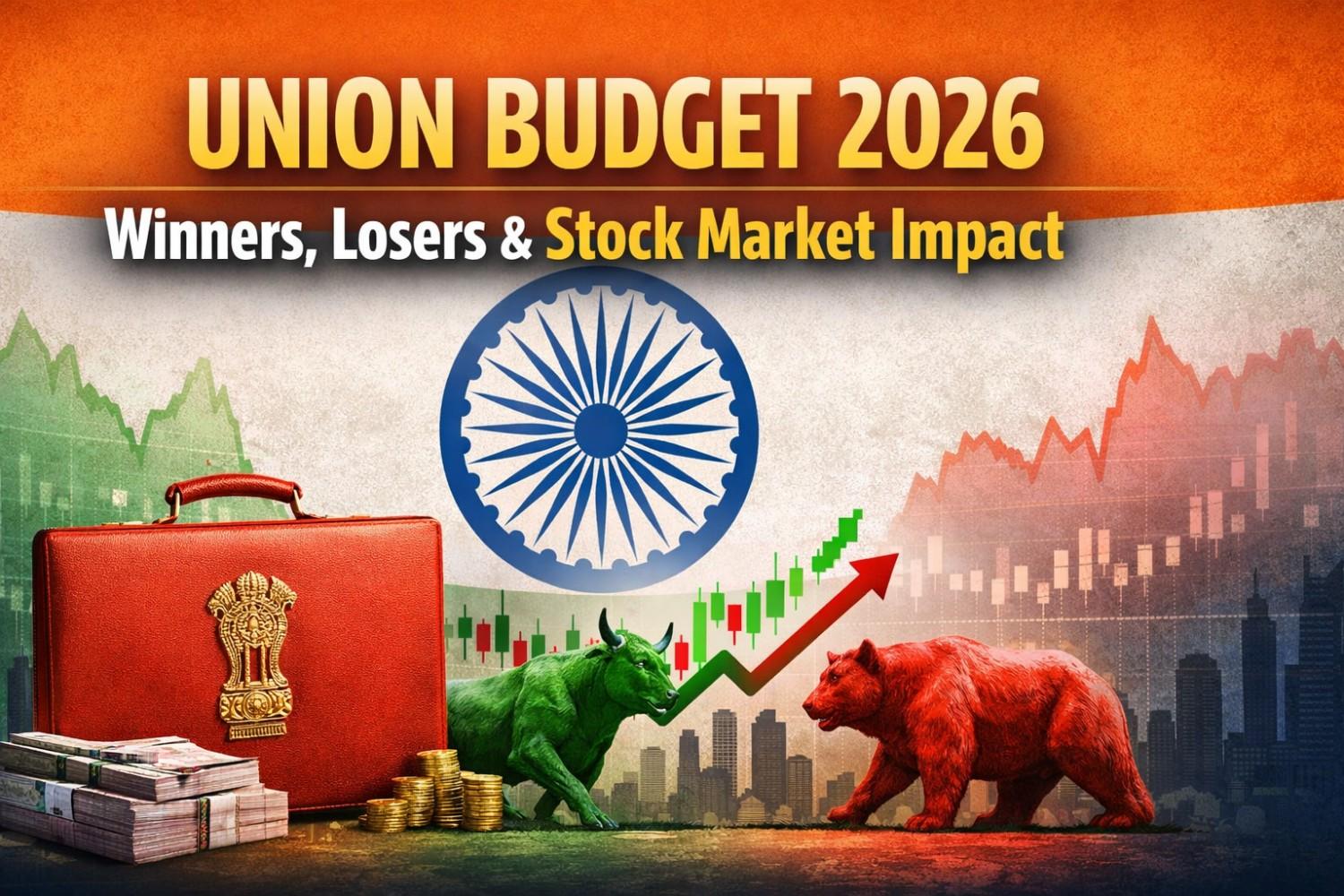
The Union Budget 2026–27, presented by Finance Minister Nirmala Sitharaman on 1 February 2026, was one of the most anticipated economic events of the year. It proposed a range of reforms aimed at stimulating growth, managing fiscal discipline, and reshaping policy priorities for sectors ranging from infrastructure to technology. Markets reacted sharply, investors revisited portfolios, and analysts began recalibrating outlook for Indian equities and bonds.
This article breaks down the Union Budget 2026 in simple language — highlighting key announcements, stock market impact, sector winners and losers, and what investors (long-term and short-term) should consider next. It is crafted for wide audience reach, strong SEO performance, and clear reading on your WordPress blog.
1) Union Budget 2026 at a Glance
The Union Budget 2026 focused on three broad themes:
- Economic growth with fiscal prudence
- Increased public investment in infrastructure and strategic sectors
- Policy support for businesses, taxpayers, and citizens
India’s total expenditure rose significantly for the upcoming fiscal year, with capital expenditure planned at ₹12.2 lakh crore — one of the highest proportions relative to GDP in recent budgets. The fiscal deficit target was set at around 4.3% of GDP, signaling continued discipline in government finances. Gross market borrowings were estimated at ₹17.2 lakh crore for FY27.
2) Key Announcements that Matter
🔹 Capital Expenditure and Infrastructure
- Capex increased to ₹12.2 lakh crore — aimed at pushing infrastructure projects including roads, ports, logistics, and railways.
- High-growth sectors such as freight corridors and urban infrastructure are targeted for long-term expansion.
Strong capex plans typically provide multiplier effects on sectors like cement, capital goods, construction and logistics, which often feed into improved earnings outlook for such stocks.
🔹 Taxation and Personal Finance Reforms
- No changes to core income tax slabs for most taxpayers — stability in personal taxation.
- Extended deadlines for revised returns with nominal fees — easing compliance.
- STT (Securities Transaction Tax) on derivatives was hiked significantly — the futures STT rose from 0.02% to 0.05%, and options STT to 0.15%.
- Share buybacks now taxed as capital gains — affecting certain investment strategies.
The tax structure stability provides clarity for salaried taxpayers and long-term investors, though the derivatives tax spike created short-term market volatility.
🔹 Strategic Sector Push — Manufacturing & Technology
- India Semiconductor Mission 2.0 launched with increased funding (~₹40,000 crore) to build domestic semiconductor capability.
- AI and data centre tax incentives introduced to deepen technology ecosystem.
- Broader “PLI-plus” initiatives gave special weightage to advanced manufacturing, electronics and critical supply chains.
This sets the stage for growth in tech manufacturing, semiconductors, and high-value industrial supply chains, which could become long-term winners if domestic output scales over the next decade.
🔹 MSMEs, Textiles & Rural Economy Boost
The budget introduced targeted support for:
- MSME growth funds and textile expansion schemes
- Integrated programs for Khadi, silk, handloom clusters
- Mega textile parks to enhance production and exports in key states like Uttar Pradesh.
This signals renewed focus on job creation, rural industry development, and export potential — themes that often outperform in structurally supportive policy cycles.
3) The Market Reaction: Why Stocks Fell on Budget Day
Despite good intentions, the Indian stock market experienced one of its worst budget day performances in years — with indices like the Sensex and Nifty 50 sliding sharply, and volatility spiking.
🔍 Major Causes of Sell-Off
1) STT Increase on Derivatives
The hike in Securities Transaction Tax (STT) impacted liquidity in the futures & options (F&O) markets, which drive most trading volume and price discovery in Indian markets. Higher trading costs immediately discouraged short-term traders and dampened volumes.
2) Lack of Immediate Foreign Investment Incentives
Global and domestic investors were watching for measures to boost foreign flows — a catalyst seen as necessary to sustain mid-term market momentum. Markets were disappointed with limited explicit foreign capital enticements.
3) High Borrowing and Bond Yield Expectations
Record borrowings of ₹17.2 trillion raised concerns that bond yields could remain elevated — which indirectly affects equity valuations and cost of capital.
4) Sector Opportunities & Disruptions
💹 Clear Winners
| Sector | Why It Benefits |
|---|---|
| Infrastructure & Capital Goods | Higher capex boosts order books and long-term demand. |
| Ports & Logistics | Emphasis on freight corridors / Supply chain efficiency. |
| Technology & Semiconductors | Mission 2.0 expands domestic tech manufacturing. |
| Textiles & MSMEs | Dedicated schemes + export potential growth. |
| Rural & Agri-linked Themes | Policy support for rural economies provides stability. |
Stocks linked to L&T, Adani Ports, select logistics and industrial themes rose on the budget’s emphasis on heavy capex, reflecting investor recalibration toward these sectors.
📉 Potential Pressure Zones
| Sector | Headwind |
|---|---|
| F&O Heavy Traders / Brokerage Stocks | Higher STT reduces trade volume and profit margins. |
| Speculative Momentum Tech Stocks | Rotation out of high-beta plays amid volatility. |
| Short-Horizon Derivatives Bets | Costs rise for frequent traders due to STT. |
The derivatives tax, while reducing speculative excess, created near-term liquidity drag and sentiment pressure, a common reaction among traders watching daily P&L.
5) Three Scenarios for the Stock Market Post-Budget
Scenario 1: Short-term Volatility, Medium-term Recovery
Markets may settle into a range with early weeks of consolidation, followed by selective bullishness in structural sectors such as infrastructure, tech manufacturing, and exports.
Scenario 2: Sector Rotation & Value Focus
Rotational investing may dominate as money flows out of volatile, short-term trades into stable, long-duration themes that benefit from policy support.
Scenario 3: Global Cues & Foreign Flows Drive Direction
If global liquidity tightens and foreign institutional investment (FII) flows remain cautious, volatility may persist. Conversely, positive foreign sentiment could reinforce recovery.
6) How Investors Should Respond
1) Long-Term Investors:
- Focus on multi-year structural themes like infra, tech, MSMEs.
- Use volatility to average in quality stocks.
2) Short-Term Traders:
- Be selective with F&O strategies due to higher STT costs.
- Consider lower frequency trading and tighter risk limits.
3) Diversification Matters:
- Equity isn’t alone — debt, gold, and diversified funds help reduce risk.
- Policy-linked sectors can outperform but require discipline.
Conclusion
Union Budget 2026 sets a balanced but ambitious roadmap for India’s economy. While markets reacted negatively in the short term due to trading cost impact, the policy thrust on infrastructure, manufacturing, and technology offers clear direction for future growth.
As markets digest the budget’s implications, investors equipped with strategic insight — rather than momentary reactions — will be best positioned to navigate the evolving landscape of Dalal Street.
Sources
Infrastructure & Stock Movement — Economic Times on capex linked stock performance.
Government Budget Documents — Official Union Budget 2026 PDFs and sector allocations.
Market Reaction & Derivatives Tax Detail — Reuters coverage of STT increase and market impact.
Top Sector Impact Stories — Times of India reports on key announcements.
Market Volatility Reports — Hindustan Times & LiveMint analysis of Sensex/Nifty movement.
Infrastructure & Stock Movement — Economic Times on capex linked stock performance.